What is the track doing?
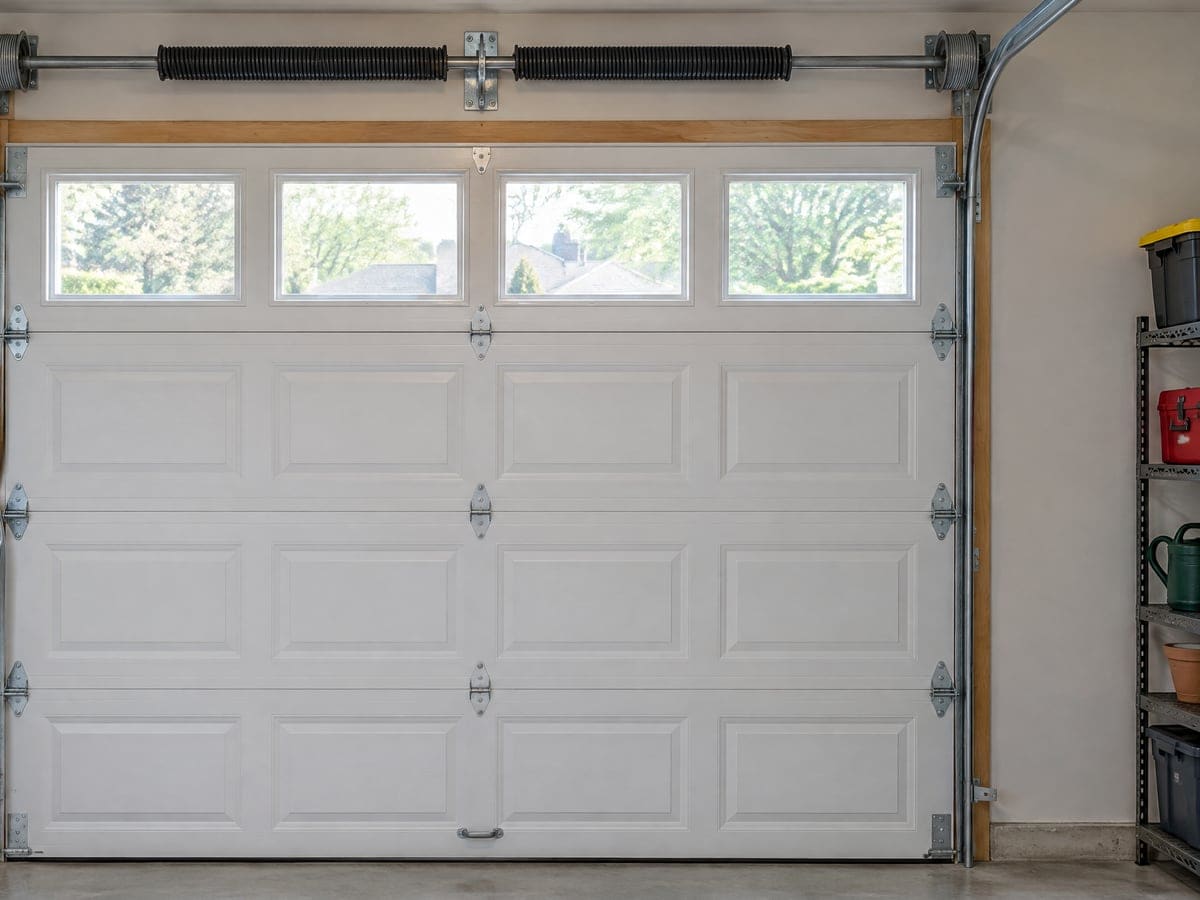
The track is the metal channel the rollers ride in. A pair of vertical sections stand along the jambs, and a pair of horizontal sections curve back under the ceiling. Track trouble shows up as catching at one spot, one side lagging the other, or a roller squealing on a particular stretch. If the door has already left the channel altogether, that is a door that has already left the track, which we handle as its own repair at the same visit.
1. Close the door and cut power to the opener
We shut the door and cut power to the opener before anything else. Track work never needs a running door, and a bent track will only push a roller further out of line if the opener keeps pulling.
2. Dents along the vertical
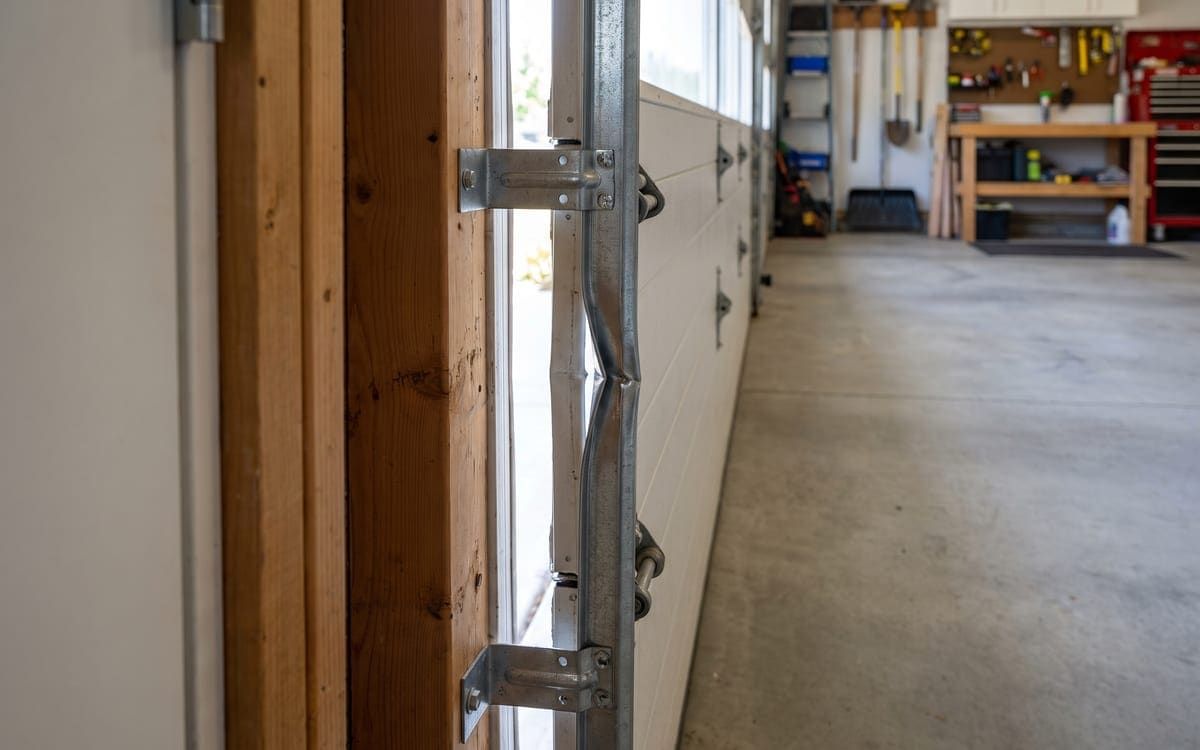
Standing at the foot of a vertical and looking up along the inside face is the way to catch any dip or hump that breaks the line. A small ding often lives with a straighten. A real crease that has folded the metal flat almost always calls for a new section, because the face never comes fully back to true.
3. Check the gap between the roller and the channel
A roller stem should sit close enough that the wheel spins clean without wobble. A gap wider than a nickel usually means the track has spread from the jamb, the bracket has loosened, or the wheel itself is worn out. A gap that grows toward the top points to flexed track. A gap that only shows at one bracket points to that bracket.
4. Feel every bracket and lag screw
Vertical track is held to the jamb by brackets driven with lag screws into the wood behind the drywall. On older garages the framing has dried and settled, and lags that were tight for years can now spin in place when a bracket takes a jolt. We put a hand on each bracket for movement and a wrench on each lag. The flag bracket at the top corner gets the same check, since that is where the two runs meet and hand off the load.
5. Look at the horizontals and the rear hangers
Horizontal track hangs from the ceiling joists on perforated straps. Over time the straps stretch, the angle iron sags, or a bump from a roof rack works the run out of level. We check that both horizontals sit at the same height, that the curve into the vertical is smooth, and that both rear ends are closed off with a stop. A sagging horizontal drops the door onto its rollers hard at the top of the run.
6. Rust at the foot of the vertical
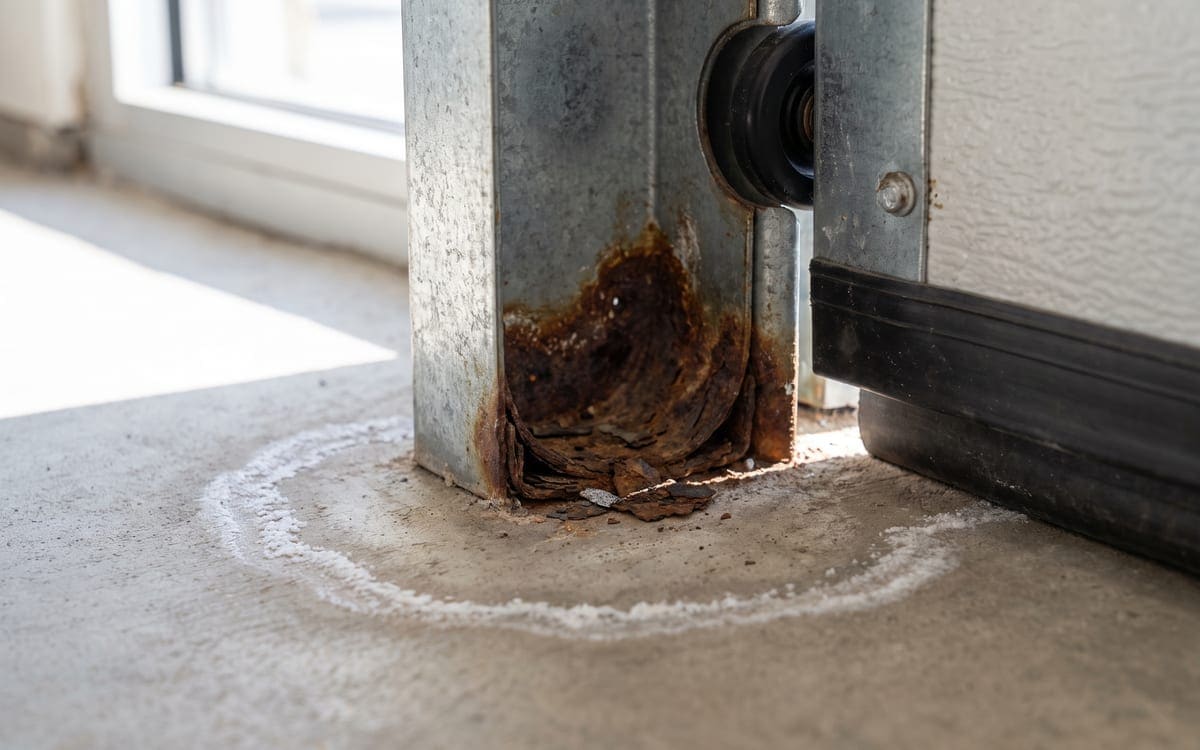
The bottom few inches of a vertical track sit at the threshold. We look for a brown crust on the inside face of the channel and any salt residue on the concrete just under it. Rust that has thinned the metal cannot be sanded back to sound steel, so a corroded-through foot is a replacement job.
For the wider look across springs, cables, panels and openers, see a full diagnosis.
| Symptom | Likely cause | What it usually needs |
|---|---|---|
| Dent or crease along a vertical | A ladder, a tool cart, or a bumper into the track | Straighten a shallow ding, or swap out a creased section |
| Wide gap between the wheel and the channel | Loose bracket, worn wheel, or a track that has spread | Realign, retighten, or fit new rollers that bind |
| Bracket pulling away from the jamb | Lag screws spinning in dry framing | Longer lags into fresh wood, or a new anchor point |
| Horizontal track sagging under the ceiling | Loose or bent rear hanger | Fresh hanger straps and a straighter angle iron |
| Rust across the foot of the vertical | Salt and slush pooling at the threshold | Swap the rusted section, then look at the cables that go slack when the door binds |
If any of that fits your door, ring (847) 440-3650 and say where it hangs up.
When we straighten and when we swap the section
We straighten a track when the steel itself is still sound. That covers a shallow dent, a bracket that has walked out from the jamb, a drooped horizontal, and any track knocked out of line because something moved without folding the metal.
We swap a section when the metal has been folded or thinned by rust. Once a track has taken a hard crease, the fold stays even after straightening, and a roller catches on it every trip. If whatever bent the track also caught the door, we look at a panel bent by the same impact at the same visit.
There is a third case. Track riding on framing that has failed does not get more track hardware. If the jamb behind the bracket has rotted, that is a repair to the opening itself, and we call it out before we price the work.
Straighten the track, or swap the section
Steel still in shape goes back to true; folded or thinned steel does not.
Steel still in shape
- A shallow dent with the flat face still sound
- A bracket that has walked out from the jamb
- A horizontal that has drooped on tired hangers
Steel folded or thinned
- A hard crease that has folded the metal flat
- Rust that has thinned the steel at the foot
- A kink a roller catches at the same spot each cycle
From your call to a fixed track
Describe where the door hangs up on the phone, with whether anything hit it, how long it has done this, and whether it started after a snow. Our technician arrives and runs the six checks with the door closed, then names the sections or brackets planned. The door runs under the opener after the repair.
Why tracks fail in Arlington Heights
Plenty of the garages here are older. Most of the village housing predates 1980: 21,073 of 33,005 units, roughly 64 percent, went up before that line,1 with a median year built of 1974.2 Framing that has dried over the years can loosen the grip a lag screw once had on the wood, so a bracket that felt solid for a decade can start to walk under load. Our technician puts a hand on every bracket and a wrench on every lag, no matter the age of the house. More in older garages and their framing.
Winter piles on. On lighter storms of two inches or under, Arlington Heights Public Works spreads a salt and liquid deicer mix to keep ice from bonding to the pavement.3 More on that in salt damage at the bottom of the track.