What is your opener doing?
Our technician listens to the motor, watches the door, and works through the small things first.
1. Power and the outlet
A dead-opener call starts here. We check the outlet, the breaker, and any GFCI on the garage circuit. If a lamp in the same outlet stays dark, the opener is not the problem.
2. Wall-console lockout and the manual door lock
Most wall consoles have a Lock or Vacation button. When it is on, the head ignores remotes and keypads while the console still runs the door. If both the wall button and the remotes stay quiet, it is not the lock mode; the trouble is power, the console wiring, or the board. A separate case lives on the door: a mechanical lock bar on the panel, when thrown, holds the door fast while the opener runs and strains. A door that will not budge while the opener runs is the lock bar or a broken spring, not the console lock-out.
3. Safety sensors: lights, alignment, sun glare
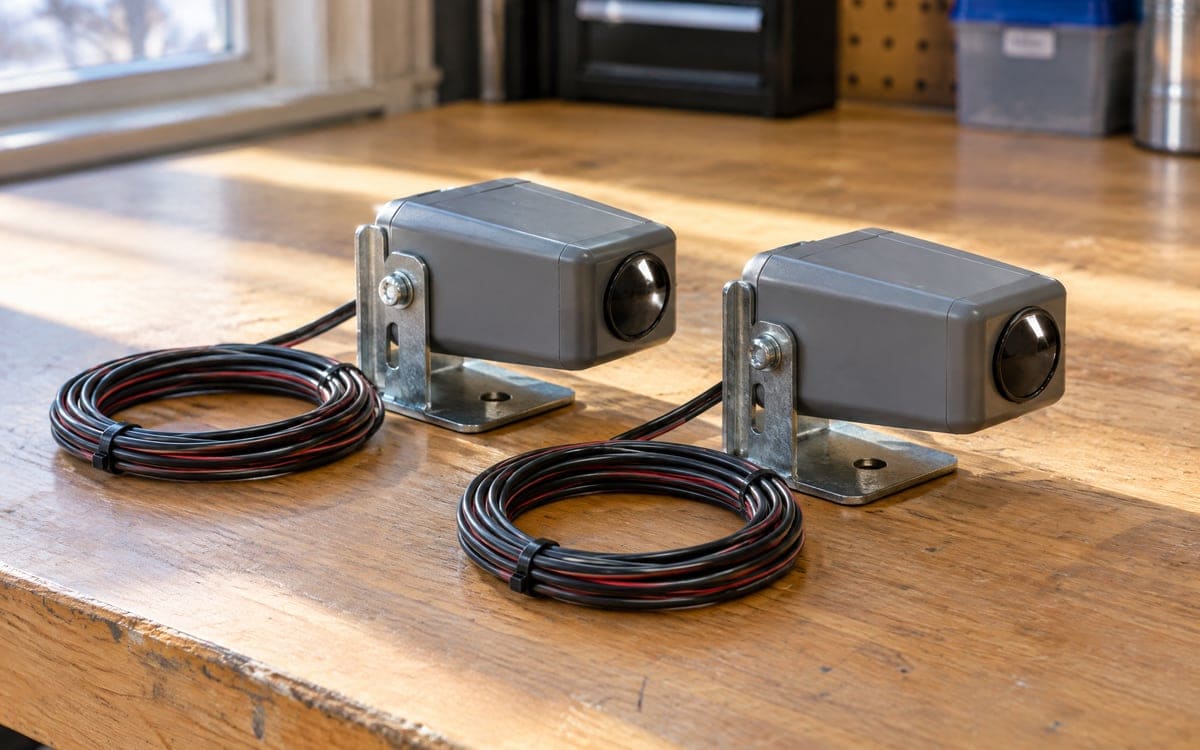
Most modern openers have two small photo eyes near the floor, one on each vertical track, watching a beam across the opening. Break the beam or knock the eyes out of sight of each other and the door will not close. We look for a solid light on each eye, a bumped bracket, a cobweb across a lens, or low winter sun blinding one side. Some openers also ship with a mode that lets the door open with misaligned sensors but forces you to hold the wall button through the close; cleaning and squaring the sensors clears that mode too.
4. Remote versus wall button
If the wall button works and the remote does not, the remote is usually the cause: a dead battery, a cracked case, or a code the head no longer accepts. If the remote works and the wall button does not, the wall control or its low-voltage wire is the trouble.
5. The motor runs but the door does not move
If the chain or belt turns while the door stays put, the trolley has come unhooked; leave it and call. On a door with a failed spring or cable, the opener had been holding the door up, so our technician checks the springs and cables and reconnects the trolley on the visit. If neither moves, the drive gear has stripped and the gear kit gets replaced.
6. The door starts, then stops or reverses
A door that reverses as soon as it starts down usually reads an obstruction. That can be a broken sensor beam, or a stiff door whose resistance registers the same way. Cold grease, dry rollers, a bent hinge or a pinched track all raise the force it takes to close. On the way up, a door that slows or stops often points to a weakened spring, leaving the opener to carry more of the door's weight than it was tuned for.
7. Humming or clicking with no door movement
A steady hum with the door still is most often the opener straining against a door whose torsion spring has broken, so the spring and balance get checked first. On a sound door, the next suspects are a jammed motor or a bad starting capacitor. Starting-and-stopping clicks are often the logic board or low-voltage transformer. If the opener has simply gotten loud without failing, a noisy opener is a different fix.
| Symptom | Likely cause | What it usually needs |
|---|---|---|
| Head is dark, nothing at all | Dead outlet, tripped GFCI or breaker | Restore power, then a head check |
| Remotes and keypads ignored, console still works | Lock or Vacation mode set on the console | Clear the mode at the wall control |
| Closes only while you hold the wall button | Photo eyes out of alignment or blocked | Sensor cleaning and realignment |
| Reverses right after touching the floor | Down-limit set too far, or close-force too sensitive | Reset travel limits and force |
| Motor hums, chain or belt turns, door stays put | Trolley disconnected from the carriage | Spring and cable check, then the technician reconnects it |
| Motor hums, chain or belt does not turn | A broken torsion spring under a stalled opener, less often a seized motor or a jammed gear | Spring and balance check first, then opener work |
| Loud pop, then the opener strains on the next lift | A broken spring can leave the opener carrying the whole door | Spring work first, opener check second |
| Remote quiet, wall button still runs the door | Dead battery, or a code the head has lost | Fresh battery, or a new pairing |
Disconnecting and reconnecting the opener
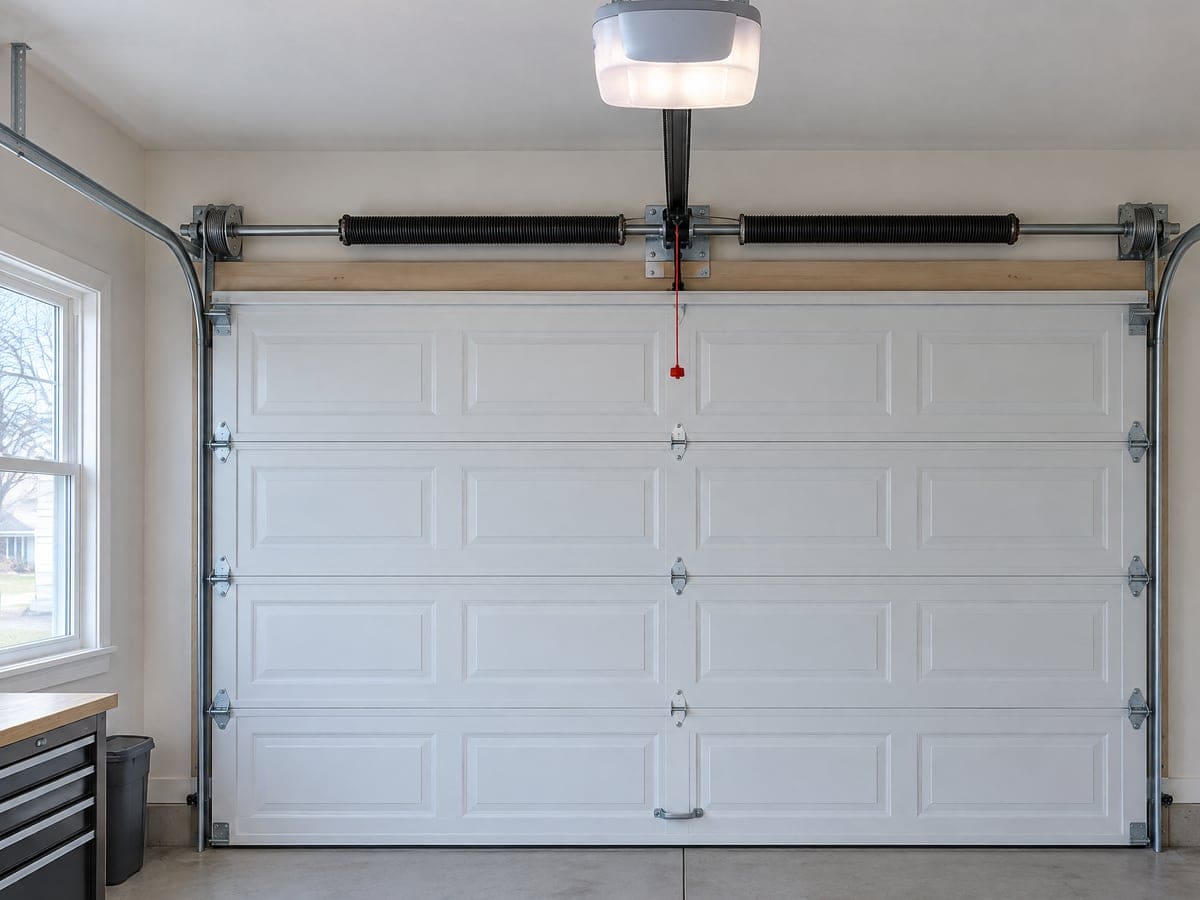
The red release rope stays alone. Our technician handles the disconnect and the reconnect on the visit.
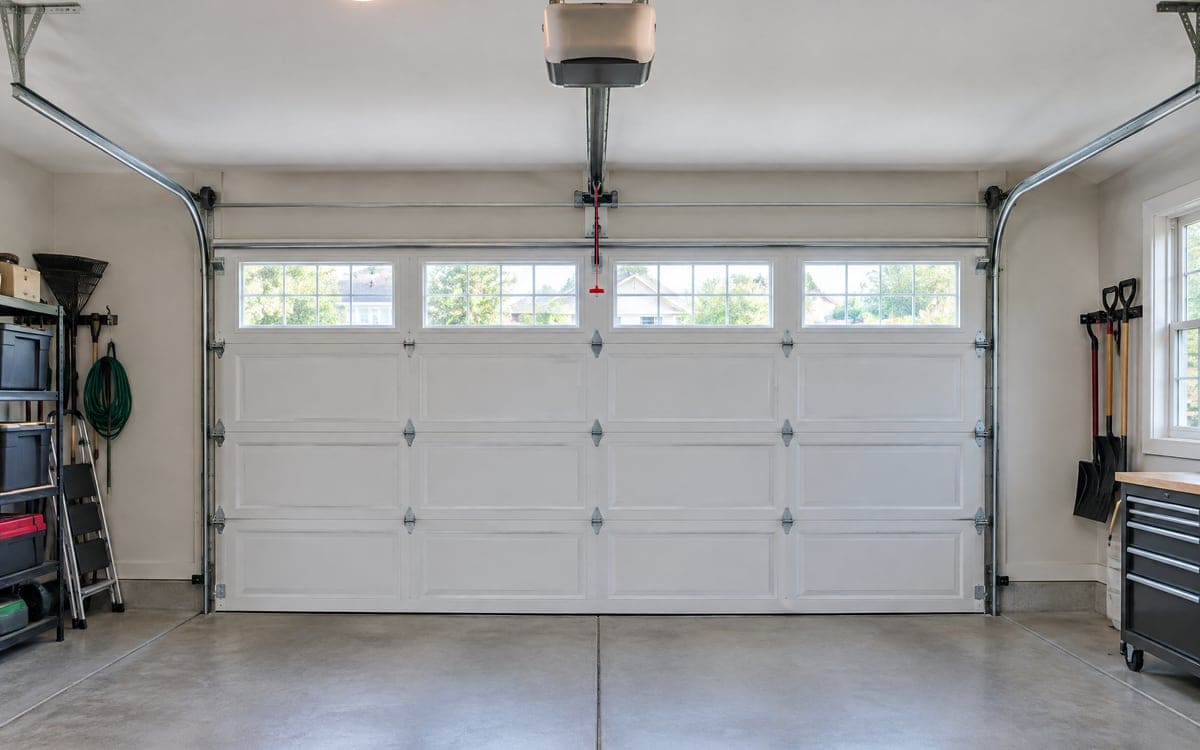
If the door looks heavier than it should, hangs crooked, or will not stay where you leave it, stop and call. A door with a failing spring is not something to try moving yourself.
Fix the opener or replace it
Opener trouble is often worth fixing. Gears, sensors, boards and remotes come apart and go back.
When we repair the opener
We repair when the frame of the opener is sound and one component has failed: a stripped drive gear on a healthy head, a bad photo eye, a burnt logic board on a unit that still has parts, or a remote that will not learn.
When we suggest a new opener
We suggest replacing the opener when parts for the head are no longer made, when the unit predates safety sensors, when the housing is cracked, or when the third fix in a short stretch lands on the same head. See also openers in older houses.
Repair the opener, or put a new one up
A sound opener with one failed part comes back; a head without sensors or parts does not.
Repair
- The frame of the opener is sound
- One component has failed on a head still in parts
- Safety sensors are at each track and working
A new opener
- The head has no safety sensors at the floor
- Parts for the model are no longer made
- The same unit has needed a third fix in a short stretch
What the visit covers
Our technician tests the opener, the door and the sensors, and checks the drive gears, sprockets, trolley, wall-control wire, remotes and keypads for what has failed. Older heads can need a part ordered; we say so at the door before anything else happens.
Your call to a working opener
- Your call. Tell us what the opener is doing and roughly how old the head is, and the brand on the motor plate.
- The look. Our technician tests the opener, the door and the sensors, then shows you what has failed, with a balance check on the door.
- On larger jobs, Illinois law requires a written contract or work order with the total cost, parts and materials, and the contractor's business name and address.1
- The repair and a full test. We fix it and cycle the door.
Age and cold on an opener in Arlington Heights
Only 3,016 Arlington Heights units went up in 2000 or later, and 74 of them in 2020 or later,2 so plenty of village garages have been around a while. An old head whose parts are no longer made tips toward replacement. Once a board or trolley fails and the model has run out of service parts, a full opener replacement is cleaner than chasing substitutes.
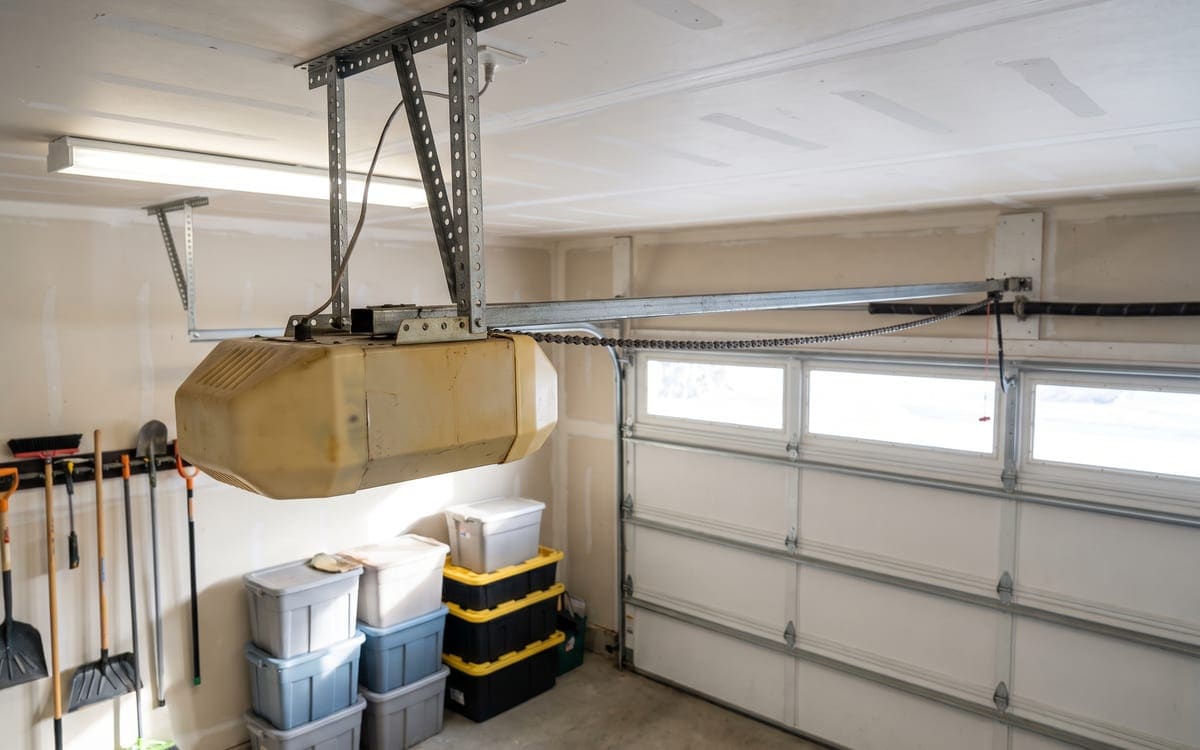
Winter puts the other squeeze on an older opener. Chicago's coldest January on record ran a mean of 10.1 degrees back in 1977.3