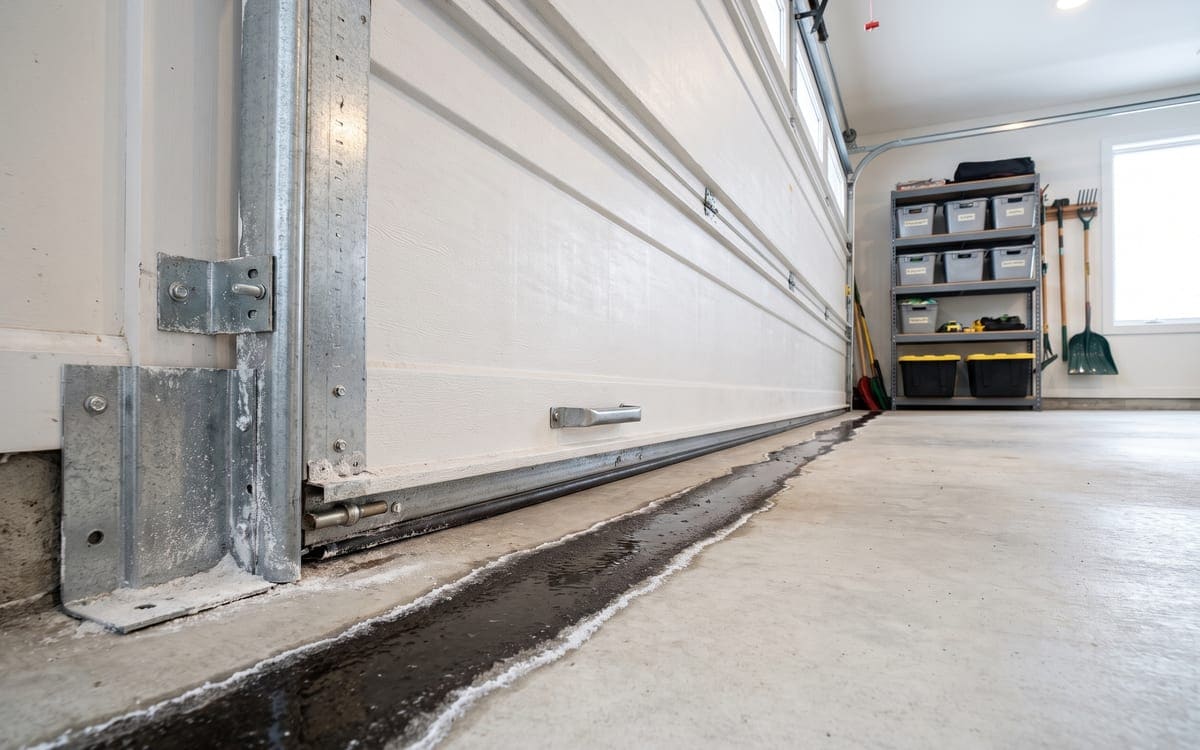
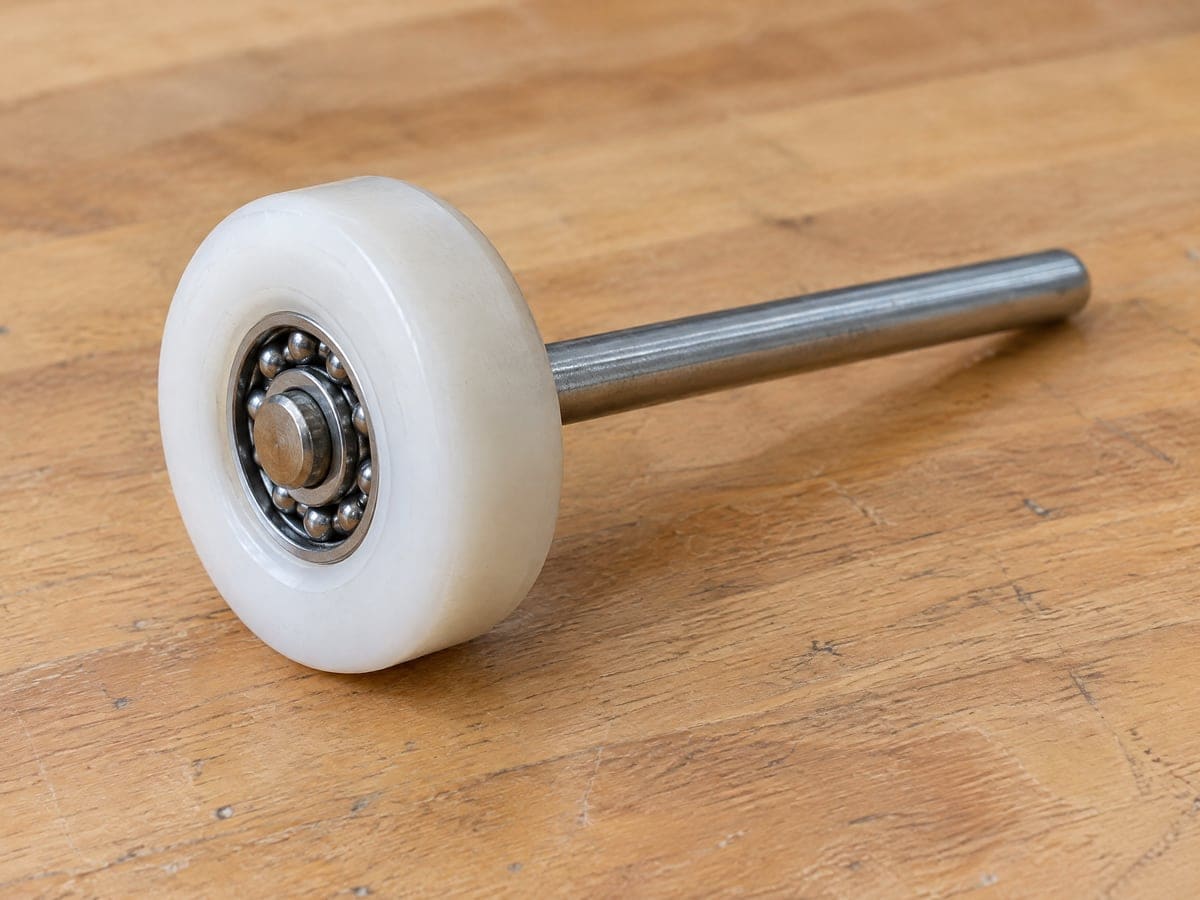
What is happening at the rollers?
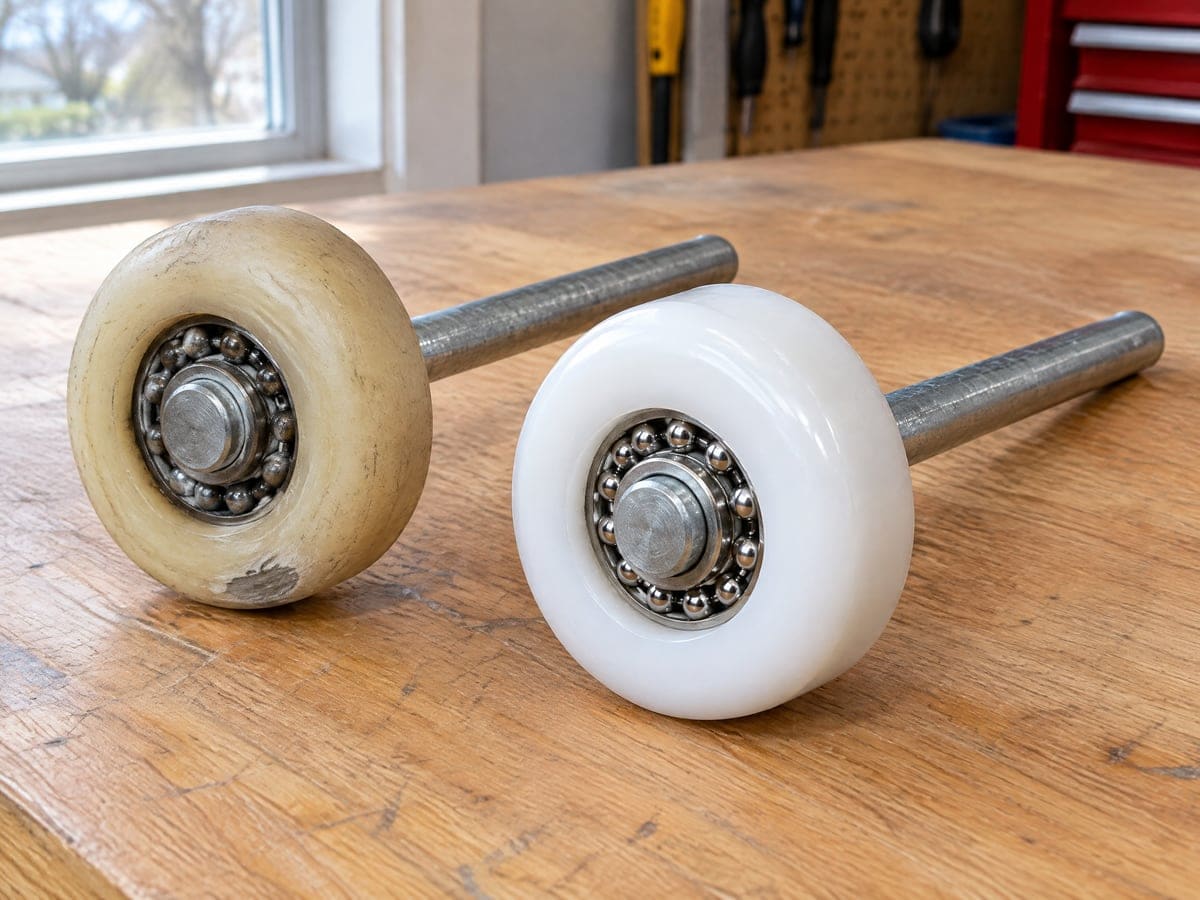
Roller wear is gradual until a bearing goes. A roller call reads how far the wear has spread, because the hinges, brackets and tracks around a bad wheel can need attention at the same visit.
1. Watch the door run
We cycle the door once with the opener and watch for a wheel that hops, holds still as the door slides past, or leans out of line at a joint. Any of those tells us where to look first.
2. Read each wheel with the door closed
With the door down, we walk the tracks and read every roller. A nylon wheel with a seized bearing skids instead of turning and wears a flat spot that thumps past the same point each cycle. A steel wheel can crack around the rim or shed its bearings. A bent stem drags the wheel in the track. We flick each roller and watch it spin.
3. Check the hinges and brackets that carry them
Rollers between panels ride in hinges, and a worn hinge often shows up before the wheel does. We look for elongated screw holes, cracks around the roller sleeve, and a gap between hinge and panel around the curve. Loose hinges throw the wheels off line even when the wheels are fine. Top rollers sit in adjustable brackets and get the same look.
4. Listen at the tracks
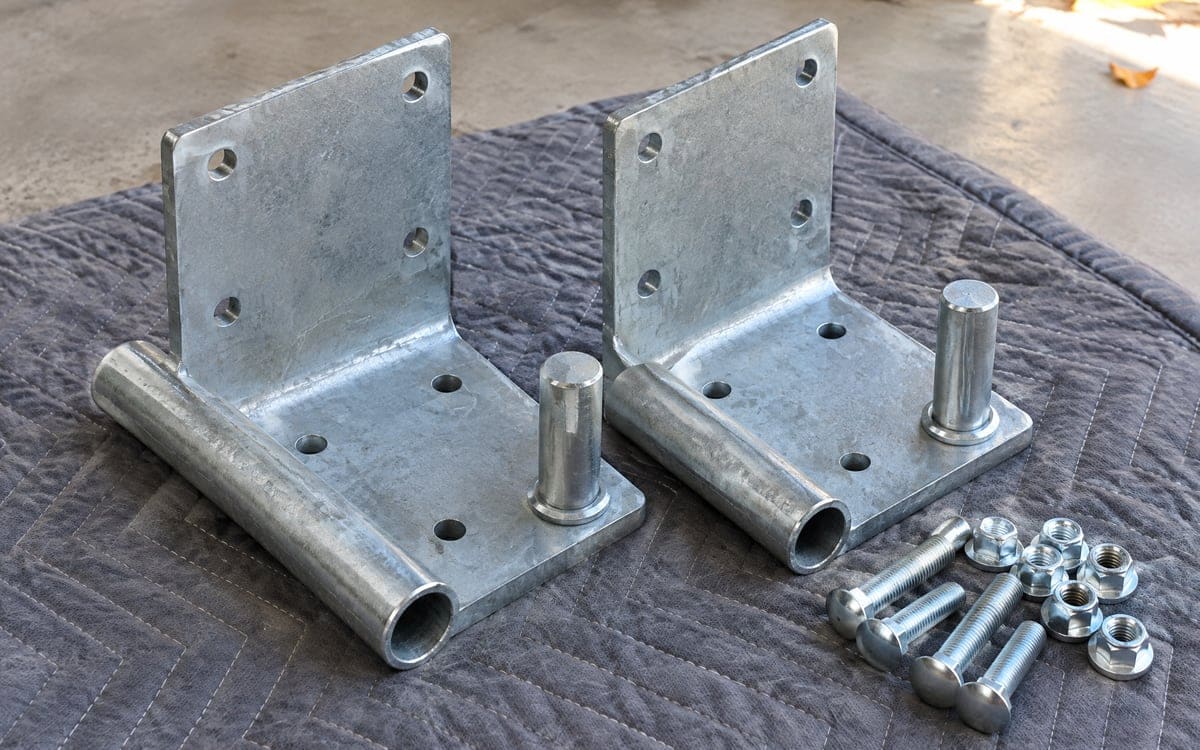
An ear a foot from the vertical track, we cycle the door again. Squeal, grinding and popping usually mean a dry, rusted or damaged wheel. A rhythmic click matched to door speed is often a flat spot passing the same point each turn. This is where we hear whether the trouble belongs to a door that has gotten loud rather than the rollers. The two bottom rollers sit in brackets that also anchor the lift cables, which pass the springs' pull to the door and carry their heaviest load whenever the door is down; loosening a bottom bracket on a closed door can release the cable anchored into that bracket and whip metal at head height, so our technician unwinds the springs first and no homeowner should touch these brackets.
Symptoms and what they usually mean
| Symptom | Likely cause | What it usually needs |
|---|---|---|
| Grinding or metal squeal along the tracks | Dry, rusted or broken bearings | A full set of rollers, sometimes with new hinges |
| Wobble as the door passes a track joint | Bent stem or worn hinge sleeve | New rollers and hinges at that section |
| A rhythmic click at the same spot each cycle | Flat spot on a nylon wheel | The affected roller replaced, and a check for what caused the flat |
| Reddish streaks and pitting on the wheels | Rust from moisture and road brine | New rollers and a look at the hardware set |
| Door leans and jumps on the way up | A loose wheel pulling a panel out of alignment | Roller and hinge work, sometimes paired with resetting a door that has already jumped its track |
Words we use for the parts
Nylon roller : A wheel with a plastic tread on a steel stem, usually with steel ball bearings inside. Only the plastic tread cannot rust; the stem and the bearing race are steel and will rust if salt water reaches them.
Steel roller : An all-metal wheel with visible ball bearings around the rim. Louder than nylon, and the exposed bearings rust once moisture and salt get in.
Sealed bearing : A bearing packed with grease and closed off with a shield, meant to run untouched.
Stem : The straight shaft that connects the wheel to its hinge or bracket.
Hinge : The plate that joins two panels and carries a roller at the panel's edge.
Nylon rollers or steel rollers
Nylon runs with a plastic tread; steel has an all-metal wheel with exposed ball bearings.
Nylon rollers
- Plastic tread on a steel stem, with steel ball bearings inside
- The tread does not rust; the stem and bearing can
Steel rollers
- An all-metal wheel with visible ball bearings around the rim
- Exposed bearings pick up moisture and dirt
When new wheels do it, and when the door needs more
When we swap only the rollers
- Only two or three wheels show wear and the rest of the set is quiet.
- The hinges are still tight and the tracks are true.
- The door is fairly young and the rest of the hardware is sound.
We change the worn wheels, check the hinges around them, and cycle the door several times before we leave.
When we suggest a full set
- Every wheel shows the same age of wear, as they usually do on original parts.
- Hinges are cracked or elongated at the screws, so new wheels alone would not hold the door in line.
- The tracks show wear in the same run as the wheels.
Then we change every roller, swap the worn hinges, and tighten the track the rollers ride in at every bracket. An older door can also benefit from a tune-up that includes the rollers.
What the visit covers
Our technician reads every wheel and the hinges, brackets and tracks that carry them. The job can include new rollers in the stem lengths and diameters common on residential doors, worn hinges, bottom brackets in common patterns, and the carriage bolts and lag screws that hold track to jamb.
From the phone through the test run
- When you ring (847) 440-3650. Tell us what the door has been doing, roughly how old it is, and whether the noise is getting worse or holding steady. If you have spotted a wheel that looks off, say where it sits.
- When we arrive. We cycle the door with the opener, then again by hand disconnected, and test the springs, the safety reversal and the balance. A dragging wheel can point to trouble upstream.
- Wheels out and test run. We change the wheels and hinges that need it, tighten the track back down, and run the door under the opener.
Why rollers wear out in Arlington Heights
The state's northern counties see roughly 140 freezing days each year and about 16 that reach zero or below.1 On storms of two inches or less, Arlington Heights Public Works applies a salt and liquid deicer mixture to keep ice from bonding to the pavement.2 More is in rusted rollers and road salt.