
Arlington Heights by ZIP code, name and housing
ZIP codes : Two ZIP Code Tabulation Areas, 60004 and 60005, account for over 99 percent of the village's land area, with 60004 at about 63 percent and 60005 at about 36 percent.1 Five other ZCTAs, 60007, 60056, 60070, 60074 and 60090, overlap only small slivers inside the village limits.1
Named : The settlement was first commonly known as Dunton, after settler Asa Dunton, and officially became Arlington Heights in 1874.2
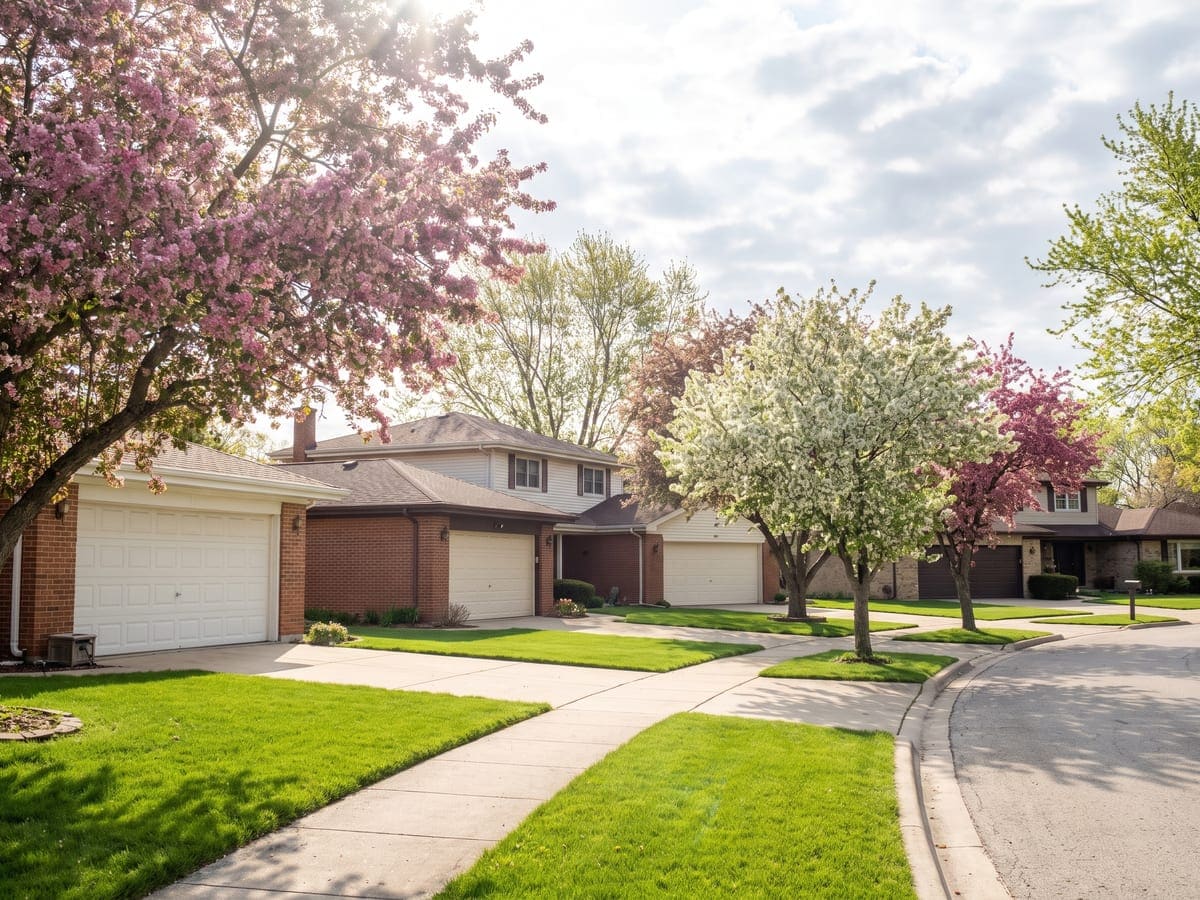
Housing stock : About 64 percent of the village's 33,005 housing units were built before 1980;3 the Census count has 17,642 single-family detached homes and another 2,206 single-family attached,4 with about three-quarters of occupied units owner occupied.5
Getting around the village
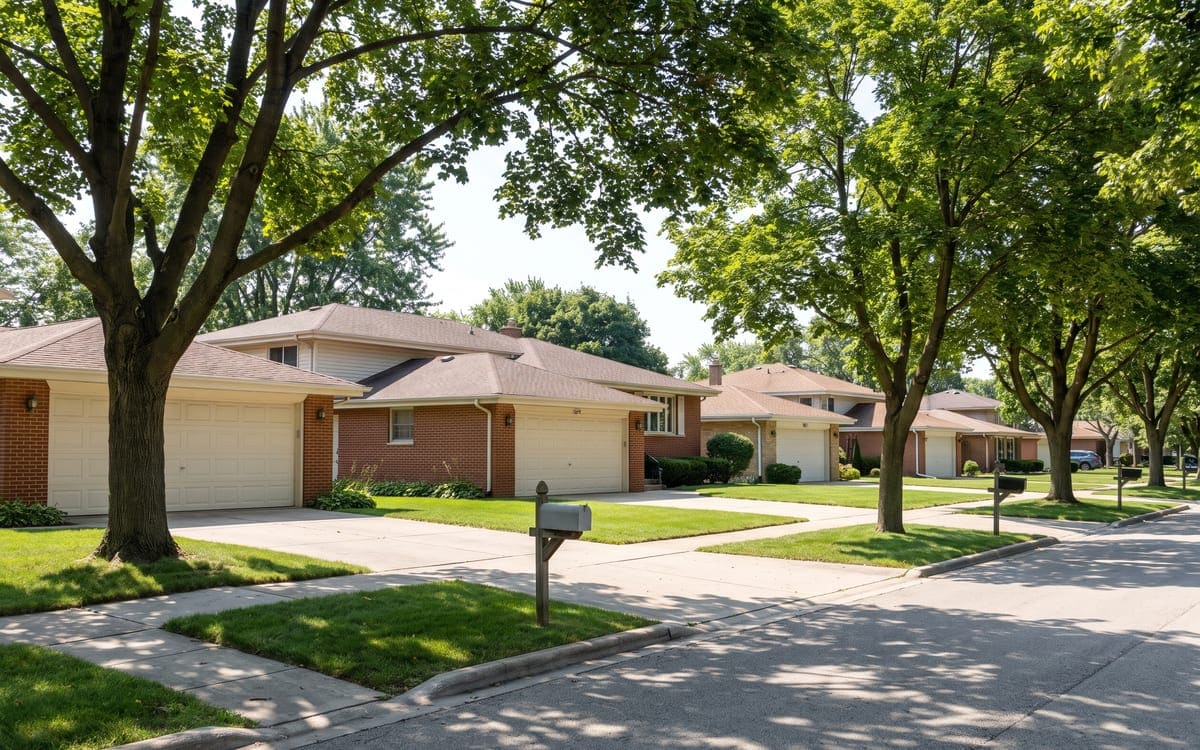
People here give directions by a handful of main roads. Arlington Heights Road north of Rand, Central, Hintz east of Arlington Heights Road and Lake Cook Road are plowed by IDOT or the Cook County Highway Department6 rather than the Village. Rand Road is signed as U.S. 12.7
The freeze and snow season at Chicago O'Hare
The bands run from the normal first date to the normal last date in the record, not days that are all frozen or snowy.
- freeze season: Oct 19 to Apr 21
- measurable snow: Nov 18 to Apr 2
Sources: National Weather Service Chicago, Normal First Freeze Information; National Weather Service Chicago, Normal Date of Final Spring Freeze; National Weather Service Chicago, Snow Climatology.
Show the numbers behind this chart
| Date | What |
|---|---|
| October 19 | freeze season begins |
| April 21 | freeze season ends |
| November 18 | measurable snow begins |
| April 2 | measurable snow ends |
Road work is thick this fall. A 6.4-mile stretch of Illinois 53 is being reconstructed and resurfaced, with the bridges over Kirchoff Road, Industrial Avenue, Northwest Highway (U.S. 14) and the Union Pacific railroad, Palatine Road and Anderson Drive rehabilitated at the same time.8 The two public sources disagree on when it finishes: the village page projects a late 2026 finish, while an IDOT release dated October 9, 2025 said the work would wrap up in 2027.8 Closer to the neighborhoods, milling has been under way on Euclid Avenue between Dryden Avenue and U.S. Route 14 since September 28, 2026,9 and White Oak Street from Weber Drive to Arlington Heights Road is a full 1.4-mile reconstruction with a tentative October 2026 finish.10 If any of that touches your block, say so on the call.
Housing by era, and what those doors need
The village's housing stock leans heavily on middle-of-the-century homes. The median year built is 1974,11 and about 64 percent of units went up before 1980.3 A longer walk through the decades is on the village's housing by decade.
Homes from before 1950
About 2,231 housing units date from before 1950,3 with 614 from the 1940s and the rest from 1939 or earlier. On a garage this old, we focus on how the door sits in its opening and whether the header can carry a modern insulated section, which points to a repair or a new door that suits the house.
The 1960s and 1970s wave
Homes from this era make up the single biggest slice of village housing. About 7,486 units date from the 1970s and 7,164 from the 1960s, together roughly 44 percent of the stock.3 Torsion springs and lift cables carry the door's weight with the door closed, and both wear by cycle count. Once a spring uses up its cycles, the door will not lift because its counterweight is gone. For houses of that era, spring repair and opener repair cover the services the age tends to call for.
The 1980s and 1990s builds
Homes from these two decades sit between the 1970s peak and the smaller share built since. On a door of this age, rollers pick up flat spots, hinges loosen, and seals dry out, so a yearly tune-up looks at the hardware before the cold. Cable work is one of the services on an older door too.
From 2000 onward
Only about 9 percent of the village's housing, 3,016 units including 74 built in 2020 or later, went up in 2000 or later.3 Springs on any door wear by cycle count, so a busy household on a fifteen-year-old door can be due for spring work well before the door itself looks tired. Cosmetic damage is also a reason for the call, and a bump from a bumper is sometimes handled with a single dented section rather than a full swap.
The services that fit each house
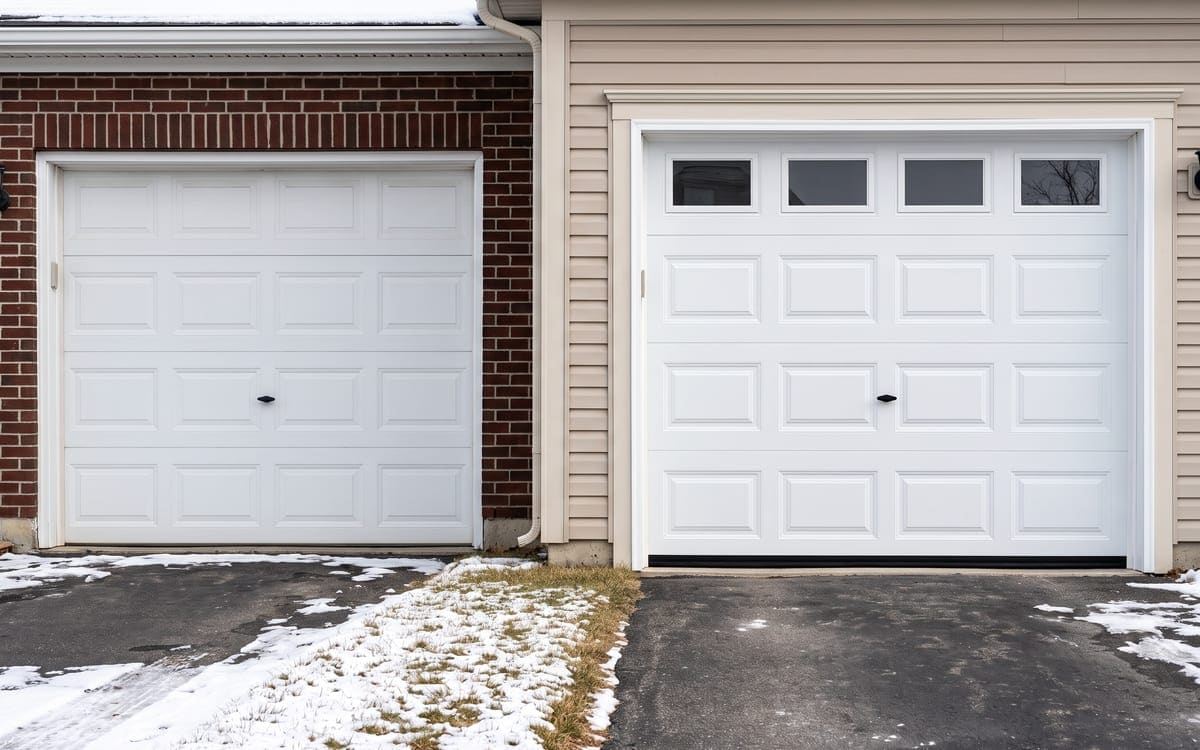
Village homes of different ages ask for different work. Spring replacement swaps a torsion or extension pair together, with the safety cable renewed on extension setups. Opener work covers the photo eyes, gears, logic boards, remotes and wall-button wiring on the unit already on the ceiling. Cable work replaces both lift cables, since the one that has just failed usually has a twin on the other side that has aged with it. A new door installation sizes a steel, wood or composite door to the opening, with fresh tracks and springs matched to its weight. Panel replacement swaps one section when the model is still in production and the rest is sound, and a tune-up looks at rollers, hinges, seals, sensor alignment and the door's balance.
Condos, townhomes and an HOA door
Not every garage door decision is yours to make. The village counts 2,206 single-family attached homes alongside 17,642 single-family detached,4 with the rest in condo and apartment buildings. Before we work up a new door, ask your board three things: which models, colors and window options are pre-approved; whether the door face is a common element or your property; and whether a preferred contractor list is in place. Every declaration reads differently.
Landmarks people use to place a house
Give us the closest landmark and we can usually place the house without the mailing address. Downtown grew up around the original train depot,2 now the Metra station at 45 W. Northwest Highway on the Union Pacific Northwest line.12 The same UP-NW line's Arlington Park stop at 2121 W. Northwest Highway12 works too. So does Village Hall at 33 S. Arlington Heights Road,13 Lake Arlington's two-mile path around a 50-acre stormwater lake,14 or any of the 58 Arlington Heights Park District parks.15