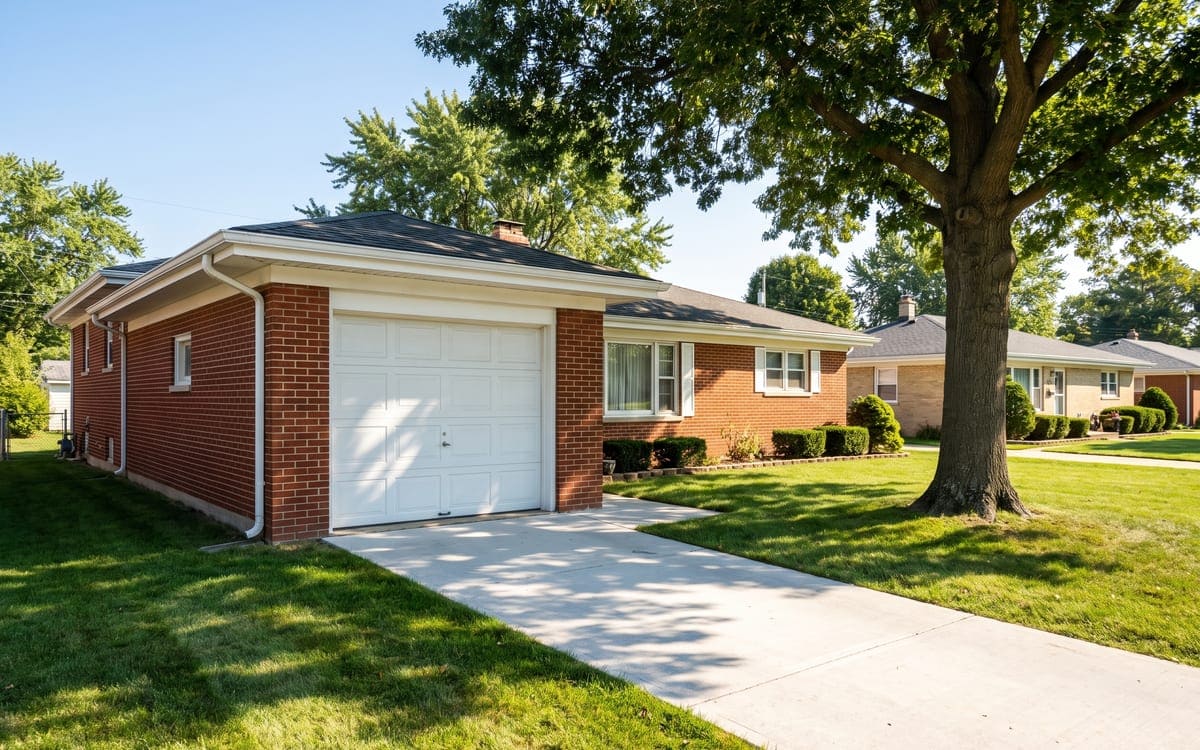
When the village's homes were built, by decade
Arlington Heights took that name officially in 1874,1 and the village's housing stock reflects a long postwar building stretch. The median year built for a housing unit in the village is 1974.2 Half the housing stock reaches further back still.
The 1960s added 7,164 units and the 1970s another 7,486, together about 44 percent of the housing stock.3 Older stock is thinner but present: 1,617 built in 1939 or earlier and another 614 from the 1940s.3 New construction is a small share, with 3,016 units built in 2000 or later, and 74 of those in 2020 or later.3
| Built | Housing units |
|---|---|
| 1939 or earlier | 1,617 |
| 1940s | 614 |
| 1960s | 7,164 |
| 1970s | 7,486 |
| 2000 or later | 3,016 |
| 2020 or later | 74 |
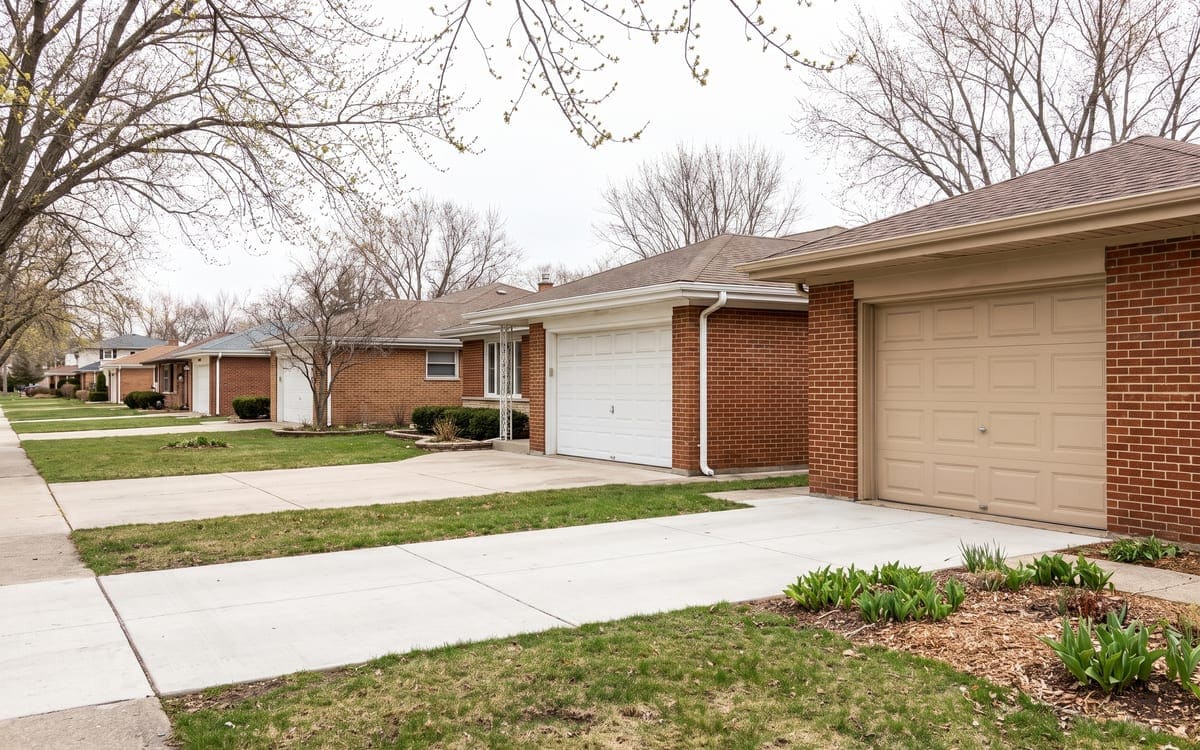
Most houses here are older than their doors should be
About 21,073 of 33,005 village housing units, roughly 64 percent, went up before 1980.3 A garage door is not engineered for a fifty-year run. Torsion springs are rated by cycles, where a cycle is one open plus one close, and a busy household uses them up faster than a quiet one.
What survives longest tends to be the sections, the hinges and the tracks, and only when the garage has stayed dry. The springs, cables, rollers and opener get renewed in pieces over the life of the door.
What a door of each era looked like at the hardware
Door design shifted with each building generation. Sectional steel and wood doors ran on torsion or extension springs through the postwar decades. A door's hardware tells us where in that history it belongs, and what still fits it today.
Extension springs and single-spring setups
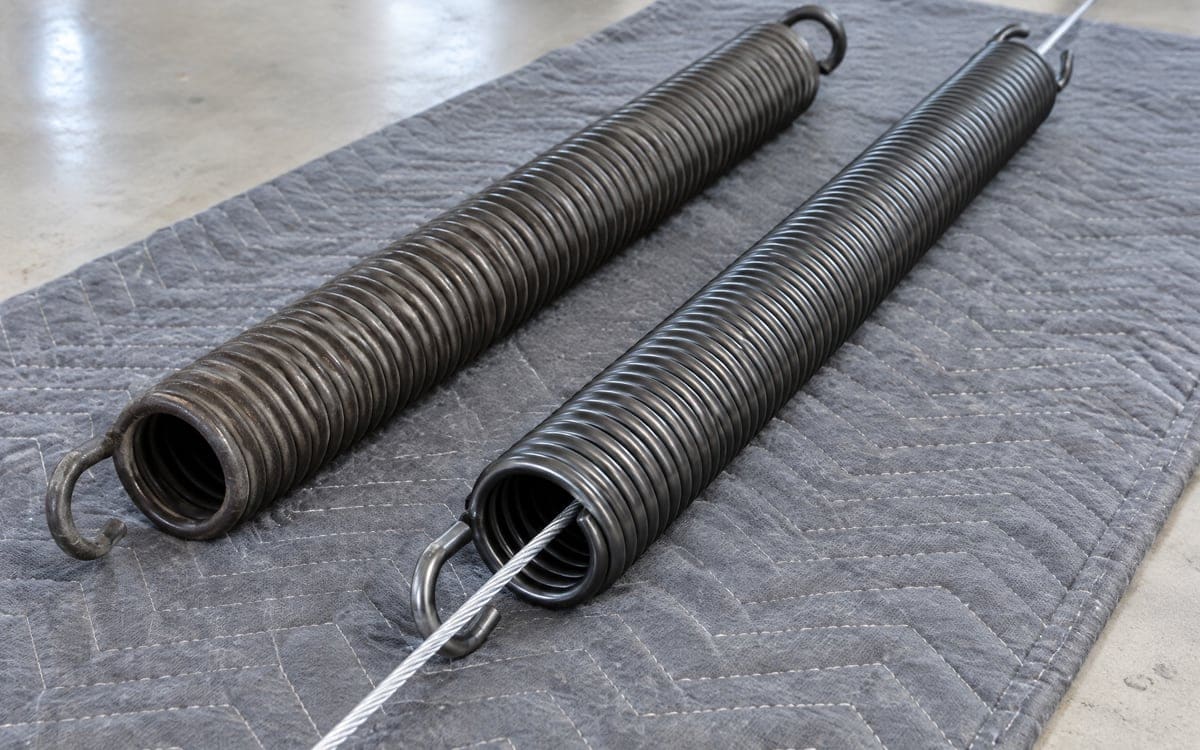
Two things matter on any pre-1980 door: how many springs it has and which kind. Torsion springs sit on a shaft above the door and store energy by winding tighter as the door closes. Extension springs sit along the horizontal tracks, hooked to the wall at the back, and stretch longer as the door closes. In both cases, tension is at its peak with the door down, and both pass their stored lift into the door through lift cables.
A single torsion spring on a wide door is one point of failure. If it snaps when the door is closed, the door is left without its counterbalance, and the opener rarely gets it moving. The other risk sits on an older extension-spring door with no safety cable running through the middle of each spring. If a spring lets go on that setup, the loose end and the fittings can travel across the garage.
If you can look up through the small window in a closed door and see a stretched spring above the horizontal track with no thin cable through the middle of it, the safety cable was never fitted. If a spring on any older door has already broken, leave the door where it is, close the interior door between the house and the garage, and call. When we get there we replace the original springs and add the missing safety cables.
Openers without low photo eye sensors
Modern openers have two kinds of protection. One is a reversal when the door hits something on the way down. The other is a secondary device, almost always a pair of photo eyes mounted at ankle height on either side of the opening that reads a beam across the threshold and reverses the door the moment the beam breaks.
An older opener with only the reversal on contact can still reverse when the door hits a bag of groceries, but the door reaches the obstruction before anything happens. Whatever is under the door gets bumped before the opener notices. A modern opener catches the obstruction before contact.
Check your own opener from the driveway with the door open. If the two low plastic units are missing, broken, aimed at the ceiling, or their wires are cut, the opener is running without them. That case calls for a newer opener with sensors, not a patch on the old one. Whatever the age of the unit, testing an older opener monthly is worth the couple of minutes it takes.
Wood doors, single-layer steel, and what time does to them
Hardboard-faced wood sectionals and single-layer steel sectionals both show up on older village homes. Each ages in a way you can spot from the driveway.
Wood soaks up water. A door left with bare wood along the bottom rail draws water into the end grain, and after enough winters the bottom section swells, splits, or rots at the corners. Hinges pull out of soft wood, and the door gets heavier as it takes on water, so the springs work harder to lift what they were sized to lift when it was dry.
Single-layer steel does not rot. It does dent on the inside, where the factory paint was thin, and it rusts from that side out.
Both kinds carry the era's hardware: loose hinge pins, squeaky rollers with unsealed bearings, a bottom seal cracked where it meets the floor. A tired door with sound panels can be a good candidate for a single tired section. A door soft along its rails or rusted through its base is not.
Townhouses, condos and who decides about the door
The village counts 2,206 single-family attached homes,4 with the rest of the stock in condominium buildings and apartment complexes. In those homes, the door can be subject to the association's declaration. The panel and paint on the outside can belong to the association as a common element, while the springs, rollers, opener and other interior hardware sit with the owner. Which is which depends on the declaration, and every declaration reads differently. Before we recommend a new door on a home with a board, we ask the owner to check what the declaration covers, which colors and window inserts are already approved, and whether a preferred contractor list is in place. Insulating an older garage is worth the same call.
What to check first on a door that came with the house
If you just moved into a home built before about 2000, a few things can be looked at from a safe distance, with the door closed and everyone clear of it. The manufacturer label sits inside the door, usually on the second section up from the bottom; if the label is gone or the maker is long out of business, replacement panels may not be sourceable, and the bottom seal and bottom section on an older door often tell the next part of the story through cracks, daylight, rust, soft spots or a slight bow.
- Look at the spring above the door or the pair of springs along each horizontal track. Note whether the setup is a single torsion, a double torsion, or extension springs, and whether the extension springs have a thin safety cable through the middle.
- Look at the motor unit and the safety sensors. Are the two low photo eyes present at ankle height, plugged in and pointed at each other?
The balance test and any hands-on look at the springs or lift cables are ours to do on a visit. If anything above looks wrong, call before you use the door any harder.
When an original door is worth keeping
A wood or steel door from the 1970s that has been painted regularly and kept dry can still be a good door, and what wears out on it is usually the parts around it, not the panels. The signs that push toward keeping it: flat and solid sections at the rails, a door that balances within a hand's tolerance on a technician's check, and hinges, rollers and panels that can still be sourced. A fresh set of springs, a full hardware refresh and a new bottom seal often bring that door back into steady use.
The signs that push toward a new door: rust or rot through the bottom section, a crack across a panel, a door too heavy for the springs the opener was sized to lift, or a style the maker no longer supports. On that line, replacing an original door usually pays back. Keep it or replace it walks the same tests, and the Arlington Heights page lays out the housing counts by decade.