What the cables actually do on a torsion door
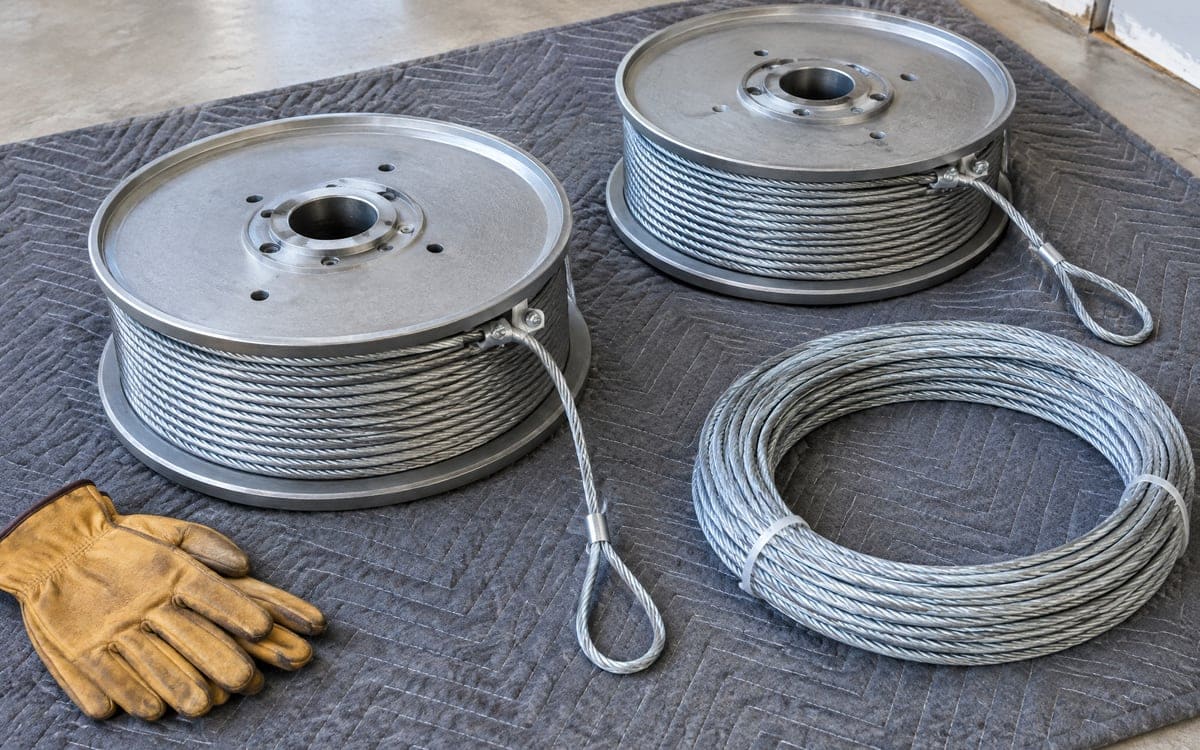
A lift cable anchors at each bottom corner, travels up the side of the door, and winds onto a drum at the end of the torsion shaft above the header. The springs twist that shaft; the drums turn with it, wind the cables, and the door rises. Lifting force starts at the springs and passes through the drums into the cables, then down to the door.
How our technician reads the cables
1. Start at each bottom corner with the door down
Cables read easiest from below once the door is settled and the opener plug is pulled. Our technician sights up each side of the door, then puts a flashlight on each bottom bracket where the cable anchors. Most of what needs to be seen sits in those two runs.
2. Fraying, rust and kinks
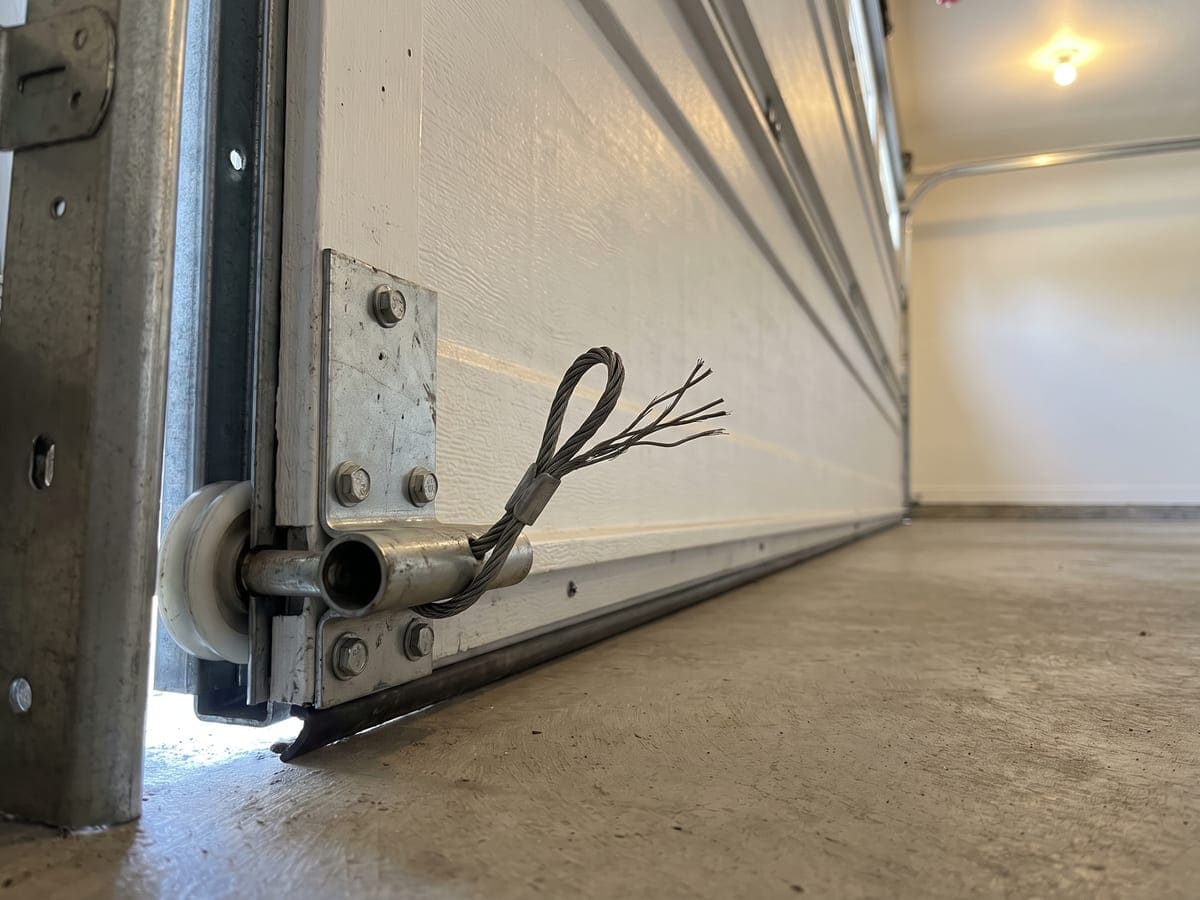
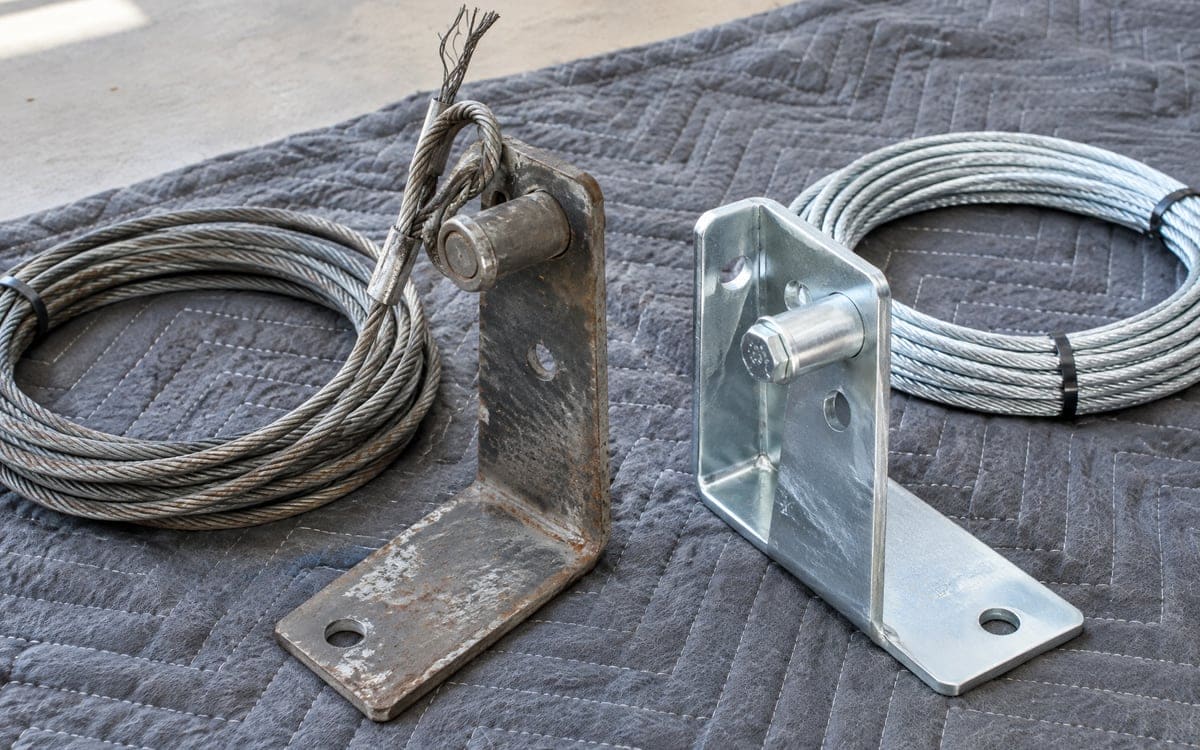
A lift cable is fine steel strands wound around a core, and the usual tells are a whisker of broken strand, a dark rusted section against clean wire, or a flattened bend where the cable has jumped a drum groove. Any of those means the cable has spent its life.
3. Slack in the line or a cable off the drum
When a cable hangs loose on a closed door, either a spring has let go and stopped holding tension, or the cable has hopped out of its drum grooves and unwound. Slack on one side alone pulls the door out of level, so the diagnosis has to read spring, drum and cable together.
4. A door that lifts crooked
If one corner leaves the floor before the other, one cable is winding and the other is not. That points to a cable off its drum, a slipped drum, or a broken cable on the low side. We do this check by hand with the opener off. Running the opener into a crooked lift drives the door into the vertical track and turns a cable call into a call for a door knocked out of its track.
5. Why the bottom bracket stays a technician's job
The bottom bracket holds the cable end under whatever tension the springs are putting on the system, and with the door closed that is the peak. If a bolt in the bracket comes free while the cable is loaded, the anchor can whip out. Cable ends, bottom brackets and drums are not places for a homeowner to start.
| Symptom | Likely cause | What it usually needs |
|---|---|---|
| Broken strands showing on a cable | Age, corrosion or a rubbing point | New cables on both sides |
| Cable hangs slack on a closed door | Cable jumped the drum, or a spring has let go | Rewind the drum and check the spring |
| Cable off the drum with the door partway up | Drum slipped, or the door hit something | Reset the drum, look for bent track |
| One corner leaves the floor first | Broken or slipped cable on the low side | New cables and a drum reset |
| Rusted, seized bottom bracket | Salt and moisture at the threshold | New brackets, cables and hardware |
The spring, drum and cable chain
Springs and cables work in series. Lift starts at the springs, moves through the drums, and reaches the door through the cables. A broken spring usually leaves the cables slack or off their drums, and a cable that snaps under load can jolt a spring hard enough to send it too. A cable visit also checks the spring that turns the drums and the drum hardware along with the cable that got your attention.
From spring to drum to cable to bottom bracket
The chain the lift travels, with the spring turning the drums above the door and the cables carrying that tension down to each bottom corner.
- Winding cone (outer end)
- Torsion springs one on each side of center
- Center bracket anchors both springs
- Shaft, across the top
- Cable drum
- Cable drum to bottom bracket
- Bottom bracket
- Vertical track
- Rollers in the track
- Four door sections
When we swap the cables, and when the job grows
For most cable calls, the fix is a matched pair of new cables. Two put on the same day age at the same rate. We size them for the door, wind the springs, level the drums, and cycle the door.
We suggest a wider job when the hardware around the cable is also gone:
- A drum with a chewed cable groove or a stripped set screw
- A bottom bracket that has rusted through or cracked at a bolt hole
- A broken hinge or bent bottom rollers and brackets the cable has been dragging on
- A torsion tube that has bowed from a past spring failure
In those cases we bring the whole assembly back into shape.
From your call to the drive home
- On the phone. When you dial (847) 440-3650, mention where the fraying sits (bottom corner, mid cable, near the drum), whether the door is up or down, and whether you heard a bang.
- At the door. Our technician looks over both cables, both drums, both springs and the two bottom brackets before a tool comes out.
- The go-ahead. Our technician names the drum work and the cables planned. For jobs over the state threshold, Illinois law requires a written contract or work order with the total cost including parts and materials, and the contractor's business name and address.1
- The work and a run through. We swap the cables, wind and set the springs, level the door on its drums, and run it by hand and by opener.
Cables, salt and cold in Arlington Heights
Cables live at the wettest, saltiest part of the door, where snow and slush cross the threshold.
The Village mixes brine, calcium chloride and sugar beet juice into its rock salt2 so the trucks spread less salt overall.
Winter runs long. At Chicago O'Hare, the normal season for measurable snow runs from November 18 through April 2,3 and Northern Illinois averages 140 freezing days a year, with 16 that fall to zero or below.4 See what salt and slush do to cables for more.
Two habits help without going near loaded hardware: park nose out on wet days, and sweep any melt inside the door line before it dries into a salt ring at the corners.