How much salt Arlington Heights roads get
Village crews do not wait for a plowable snow to put salt down. When accumulations are two inches or less, Arlington Heights Public Works crews apply a salt and liquid deicer mixture to keep ice from bonding to the pavement.1 Separately, the Village pre-wets its road salt with a blend of salt brine, liquid calcium chloride and sugar beet juice so it can use less rock salt.1
The salt season rides along with the snow season. Chicago's normal first measurable snowfall at O'Hare comes on November 18 and the normal last on April 2.2 The area's normal seasonal snowfall is 38.4 inches,3 and northern Illinois sees an average of 140 days a year at 32 degrees or lower and 16 days at 0 degrees or lower.4 That is a long stretch of the calendar when a car can bring brine home.
| Winter figure for the area | Number |
|---|---|
| Normal seasonal snowfall | 38.4 inches |
| Normal first measurable snow at O'Hare | November 18 |
| Normal last measurable snow at O'Hare | April 2 |
| Northern Illinois days at or below 32 degrees F | 140 |
| Northern Illinois days at or below 0 degrees F | 16 |
It rides in on the car and melts at the door
Nobody spreads salt on your garage floor, but the salt gets there anyway. Every wheel well collects a slushy paste of brine and snow, every trip out lifts more into the wheel arches, and every trip back drops some of it in your garage.
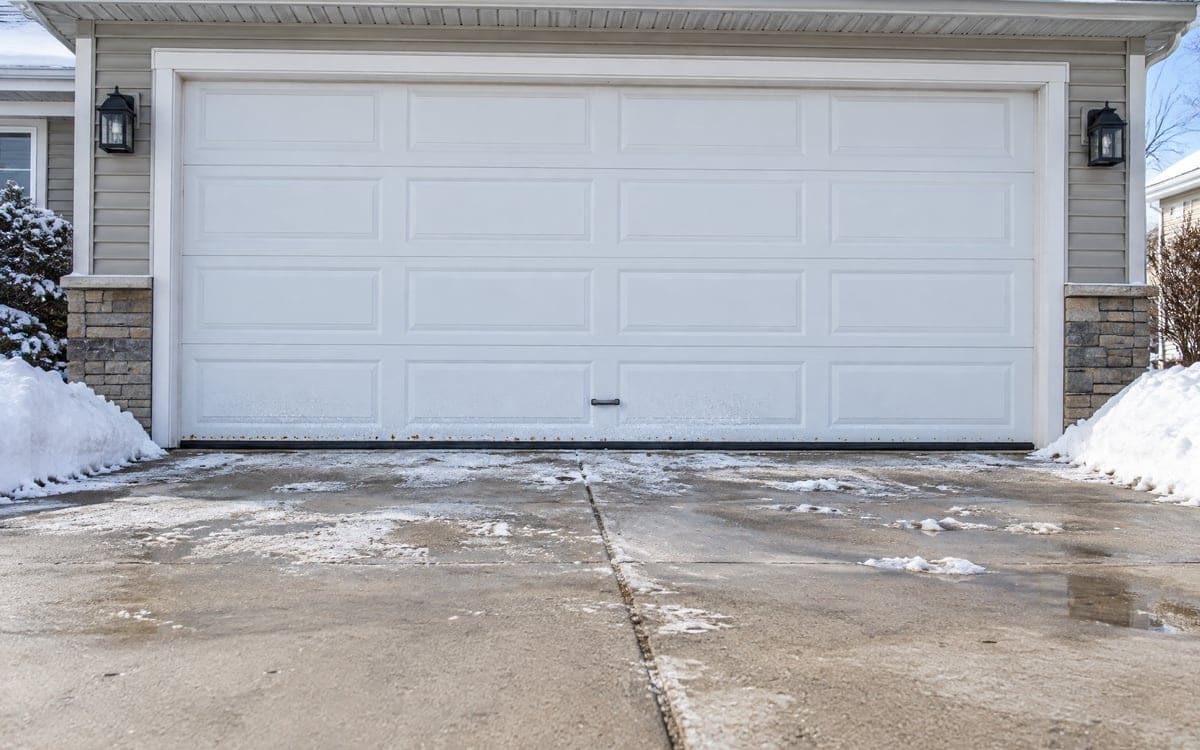
Once the car is parked and the metal warms up, whatever was frozen to the underbody thaws. The runoff drips off the tires and the rocker panels and pools where you park. On a two-car garage that means a wet stripe a few feet inside the door across the width of the parking bays.
When the puddle dries, the salt does not go with it. What is left is a fine film of chloride waiting for the next humid day, the next damp car, or the next melt from a snow boot.
The bottom three feet take the damage
Warm air rises, so the cold, moist air settles at the floor. Salt water follows gravity into the low points, which in most garages means the joint between the door and the slab. The bottom panel of the door, the bottom brackets, the ends of the vertical tracks and the roller stems near the floor sit in that layer for hours after you park.
Anything above waist height dries out quickly, while the bottom few feet stay wet long after the air feels dry. Hardware above that line comes through winter cleaner.
Cables and bottom brackets
The lift cables anchor at the bottom brackets on each side of the door. Those brackets sit only inches above the slab. Each cable runs from the bracket up along the vertical track and winds onto a grooved drum at the top corner. The drum is fixed to the torsion shaft, so when the spring turns the shaft, the drum turns with it and the cable winds on to pull the door up. On the way up the cable passes through the exact zone where salt and water pool.
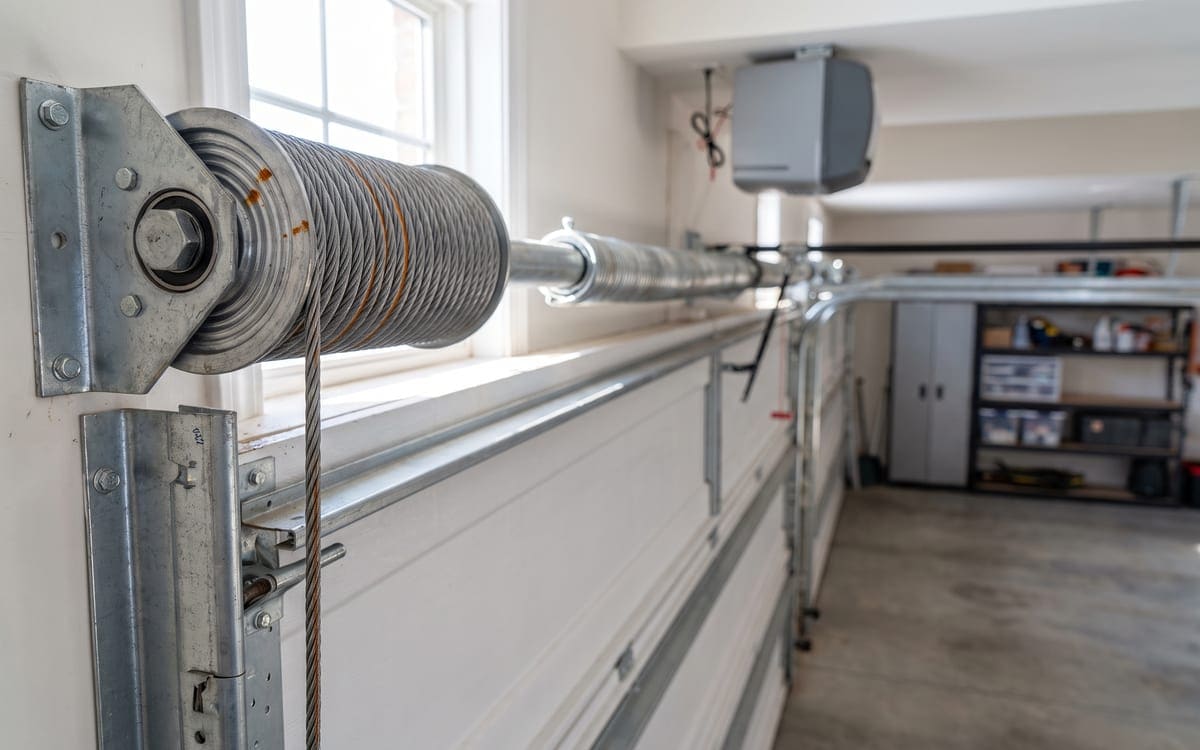
A lift cable is a braid of steel strands. Water gets between the strands and stays there. Once rust starts on the wire inside the braid, no rinse from outside will reach it. You see a hair-thin orange line at the drum first, then a strand pops loose, then the cable frays for real.
We handle that as cable and bottom bracket repair, always on both sides. A cable that has corroded on one is the same age as its twin.
Where the cables and bottom brackets sit
The low end of the lift chain, down where salt water pools: a bracket at each bottom corner anchors a cable that winds onto a drum above the opening.
- Winding cone (outer end)
- Torsion springs one on each side of center
- Center bracket anchors both springs
- Shaft, across the top
- Cable drum
- Cable drum to bottom bracket
- Bottom bracket
- Vertical track
- Rollers in the track
- Four door sections
The bottom brackets themselves hold spring tension whenever the door is closed. Never take one apart. If yours is bubbled with rust or looks pitted at the bolts, leave it alone and call.
Rollers, hinges and track ends
Rollers turn all winter through whatever is on the floor. On a nylon wheel, the outer surface is fine, but the steel stem and the bearing race inside are steel. Salt water works its way in, the bearing gets rough, and the roller wobbles or squeals on the way up. Once a bearing is packed with rust, no amount of lubricant fixes it.
Steel rollers are worse, because the wheel itself takes damage. When a steel wheel loses its round shape, every rotation thumps in the track.
Hinges at the bottom two panels catch the same spray. The pivot holes elongate as rust flakes off the pin, and the panel starts to sag at the corner. When the whole set has aged together, rusted rollers and hinges usually go in as a set on a tune-up.
The tracks themselves gather slush at the floor, and salt collects in the channel the rollers ride in. Rust flakes act like sand under the wheel, wearing the track edge and making the door louder every month. If you see orange in the bottom foot of the track, we look at it as track rust at the floor; sometimes it cleans up, and sometimes the vertical section needs a new piece.
Steel panels and the bottom seal
On a steel sectional door, the face and back skins are painted or coated, but the bottom edge is often bare cut steel with only a thin factory coating. That edge sits behind the astragal, the U-shaped weather gasket that runs the length of the bottom section. Water pools between the gasket and the panel, and the salt in it goes to work on the exposed steel.
You do not see the damage at first. Rust starts inside the pan of the bottom section and works outward. By the time paint blisters on the outside of the door, the steel behind it is thin. Fingers can push through a season later.
Wood doors follow the same path with rot instead of rust. Either way, a rusted bottom section sometimes gets replaced on its own if the model is still made. If it is not, the door goes.
The gasket itself hardens after a few winters. A seal that no longer flexes lets more slush past, which puts more water on the very panel the seal was supposed to protect. Changing out a cracked seal while the panel behind it is still sound is far cheaper than replacing a rotted bottom section later.
A spring rinse routine
Once the roads are dry enough that your car is not dropping slush on the way home, a bucket of warm water and a soft-bristle brush handles most of what winter left behind.
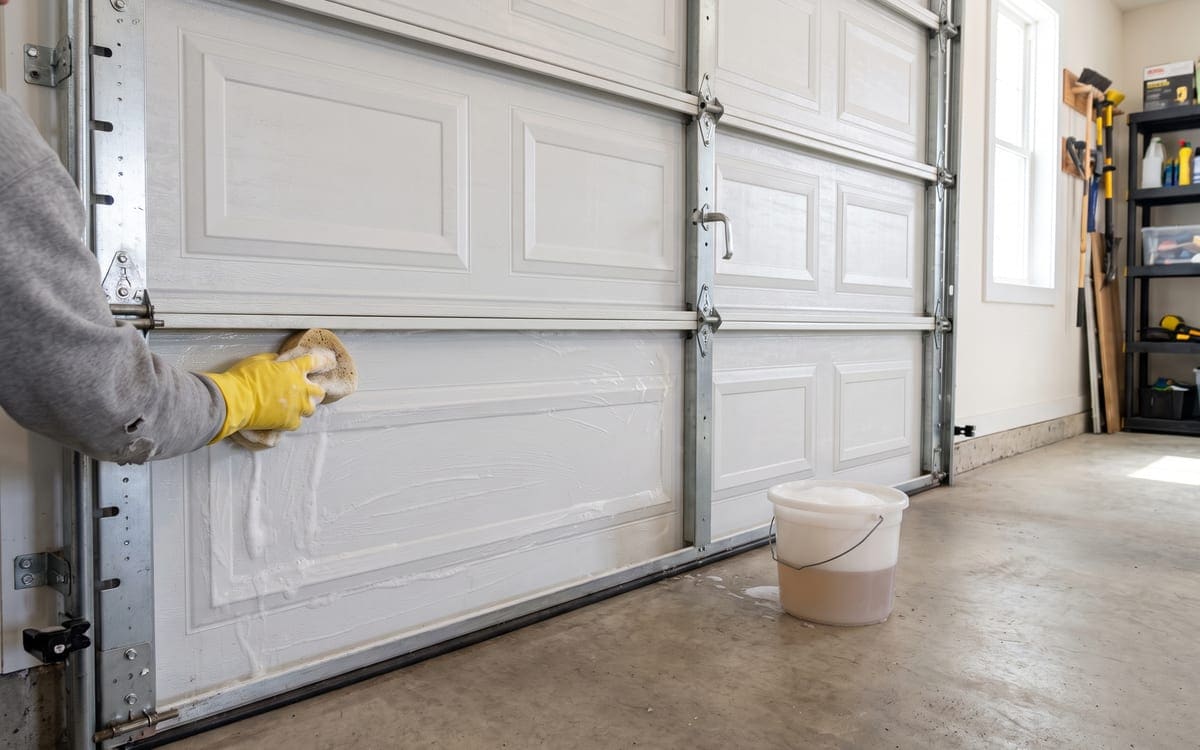
Work from the inside of the closed door. Sponge or brush the bottom panel front and back. Look at the bottom corners, the ends of the vertical tracks and the roller stems without touching them; the brackets there hold spring tension and the lower hardware sits beside them. Sponge, do not spray. A steady soak breaks up the salt film. Then rinse it off with a bucket. Let everything dry.
Once it is dry, put a proper garage door lubricant on the roller stems and the hinge pivots. Skip the tracks; grease on a track holds dust and makes the rollers worse. A can of white lithium spray or a purpose-made garage door lube works. Motor oil and thin penetrating oils do not. The spring coils are not a homeowner job; a tune-up lubricates them.
This pairs well with a spring tune-up after winter, which is the visit where a technician reads the door's balance and looks at parts you cannot see.
What should never be sprayed
Skip the pressure washer. It drives water into the roller bearings, into the opener sensors and up into the top seams of the door, which is exactly the moisture problem you are trying to solve.
Keep water off the opener head, the wall control, and the photo eyes at each side of the door. Those parts run on line voltage and low-voltage wiring that does not want to be wet.
Do not use light penetrating oil on cables or springs. It strips whatever protective coating the wire came with and attracts dust that grinds at the metal.
Vinegar and other acidic cleaners can strip paint from steel panels. Plain warm water with a mild dish soap is enough for winter grime.
When rust means replace, not clean
Some rust is cosmetic, and some rust means a part is done. The cases below are the second kind:
- Orange between the wire strands of a lift cable. The cable gets replaced, and its partner on the other side goes with it.
- Bubbled paint on a bottom bracket with pits underneath. Bottom brackets carry spring tension and are not a homeowner part, so leave it alone and call.
- Swelling at the bottom edge of a steel panel, or a bottom seam that has separated. That section either gets replaced on its own or the whole door does.
- A hinge rusted at the pin so it no longer holds a straight line for the roller. Whole sets get changed on a tune-up.
An older door with corrosion in more than one place is worth a look before the next winter. Winter and springs covers the cycle math on a spring; insulated doors covers the step up for the next door that goes on the house.