
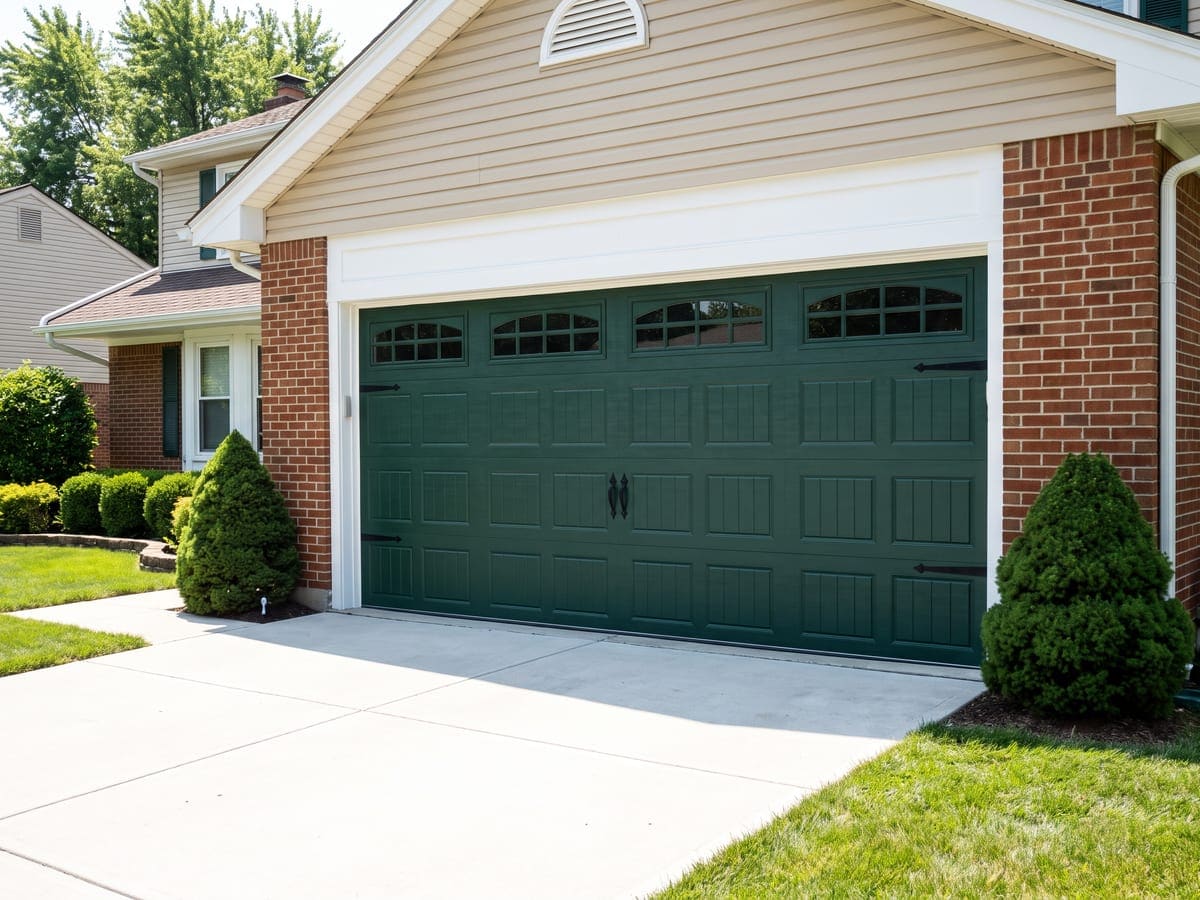
What door fits how you use the garage?
Before we look at doors, we look at the garage. A workshop you spend Saturday mornings in does not want the same door as a bay for lawn tools and a snowblower.
1. What is the garage for?
If cars and storage are the whole story, an entry-level door does the job. If the garage is heated, if you work out there, or if a bedroom over it never warms up in January, a door with a foam or polyurethane core makes sense. That choice shapes most of what follows.
2. What does the house look like from the street?
The door is the largest face the driveway shows. Newer builds tend to run flat steel panels. Older houses often read right with a carriage house style, whose panels are cut to look like doors that swing open.
3. How is the opening built?
We remeasure width, height, headroom and side room every visit. Framing gets touched over the decades: new headers, fresh drywall, a re-sided jamb. Low headroom decides whether a special track kit rides on top of the standard hardware.
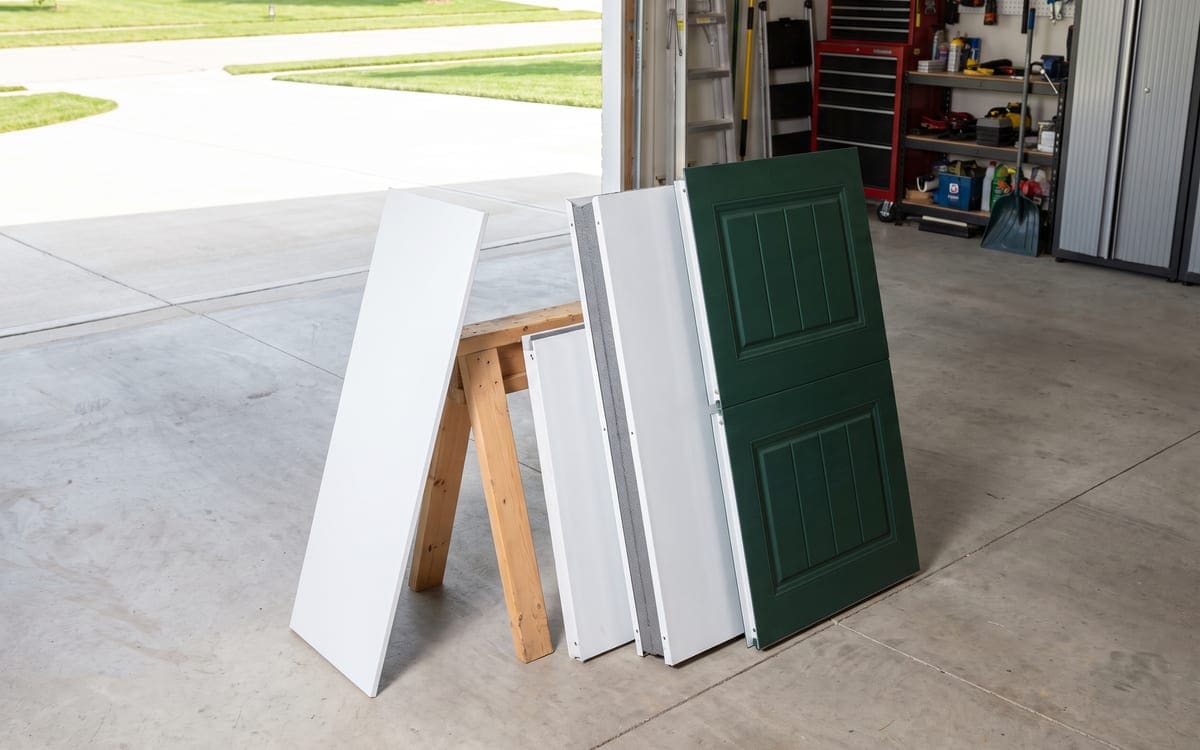
Then the materials. Single-layer steel is one skin with no insulation, the lightest and cheapest choice for an unheated detached garage. Double-layer steel bonds foam or polyurethane between the outer skin and a vinyl backer for real insulation, a quieter run and a stiffer panel. Triple-layer steel adds a second steel skin on the inside. Composite is a steel frame with molded overlays that look like wood at a distance and does not rot or warp. Wood is what a real carriage house door is built from, and it wants a refinish every few years.
Single, double or triple-layer steel doors
The build matches the garage, from a bare detached bay up to a heated room above.
Single-layer steel
- One steel skin with no insulation, the lightest option
- A fit for an unheated detached garage
Double-layer steel
- Foam bonded between a steel skin and a vinyl backer
- A quieter run and a stiffer panel than a single-layer
Triple-layer steel
- A second steel skin added inside over the foam core
- A fit for a heated workshop or room above
R-value is the insulating figure on the spec sheet. A polystyrene-filled door tests lower than a polyurethane-filled door of the same thickness, so ask for the whole sheet.
| If you want | Look at |
|---|---|
| A quieter door | Double or triple-layer steel with nylon rollers |
| A garage that keeps heat in January | A polyurethane-insulated door with thick weather seals |
| A door you can leave alone | Steel or composite in a factory finish |
| A heated workshop | Triple-layer steel, perimeter and floor seals, a wall-mount opener |
| Light in the garage | Glass panels near the top, matched to house window heights |
| A door that reads as part of the house | Carriage house panels matched to the front door |
If you are also swapping the opener, we plan for a new opener to go with it so the two are chosen together. If the door itself runs true and one bad section brought you here, when one section is all that is needed is the shorter job.
When repair still makes more sense
A lot of what looks like a dying door is one or two worn parts.
When we suggest a repair
We lean toward a repair when the panels are straight and the paint is holding, and the trouble is a single part: a torsion spring that has parted on an otherwise sound system, a fraying cable, a roller off its stem, or a bottom section dented from a bumper tap.
When we suggest a new door
A new door is the call when the bottom sections are rusted through, the top-rail seams have opened up, or a car has bent the tracks past straightening. The same goes for a thin single-layer door from decades back on a house that has since grown a bedroom over the garage, or an aged door left behind when the exterior gets repainted.
For the longer version, see how to decide between repair or replace. Not sure which side you land on? Call (847) 440-3650 and describe the door.
What comes with a new door
Sections are the door itself, four or five panels ordered as a matched set with hinges to join them. Tracks are the rails the rollers ride in; old tracks are almost never reused, because bends and wear points make a fresh door move roughly.
Torsion springs are sized to the finished weight of the new door. Heavier insulated doors need heavier springs, and new springs go in with every install. Lift cables run from a bracket at each bottom corner up to a drum on either side of the torsion shaft. Those cables carry the springs' lift down into the door, so both come new with the door.
Weather seals wrap the bottom, and often the sides and top of the opening. Perimeter seals go on when the garage is heated. If your existing opener stays, we check the safety sensors and wiring, replace the emergency release rope, fit a new door arm and bracket, and reset travel and force.
Install day
The visit takes out the old door and springs, hangs and balances the new one, and finishes with the safety tests.
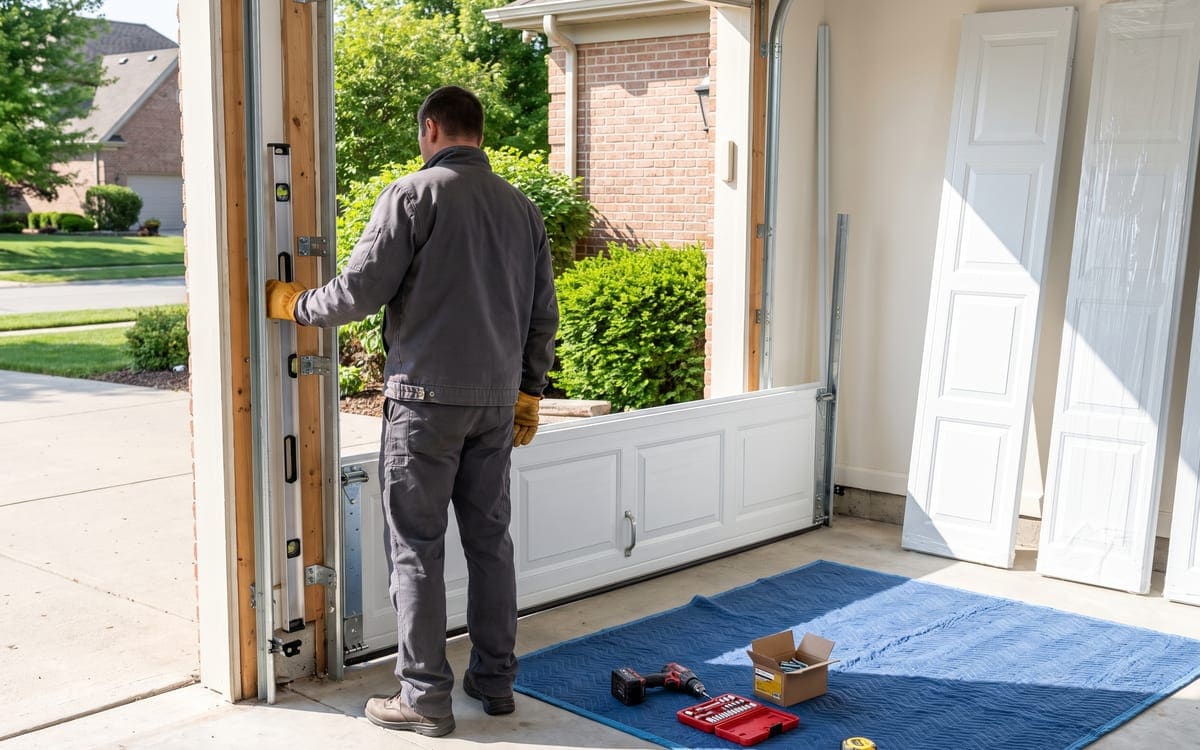
1. Measuring and checking the opening
We remeasure, check the studs are square, and confirm headroom. Shims to hang the tracks plumb get placed now.
2. Removing the old door and springs
This step is one homeowners should leave alone. The torsion springs and lift cables carry the door's weight even at rest, and our technician releases that tension before anything comes apart.
3. Setting the tracks and the first section
The vertical tracks go up plumb. The bottom section is levelled in the opening and pinned to the tracks, with rollers seated in the correct stems.
4. Stacking sections and hinges
Each section stacks on the one below it, with hinges fastened at every seam. We check the door reads as one piece before the springs go on.
5. Springs, cables and balance
The header bracket, torsion shaft, drums and springs mount up. Cables run down and anchor at the bottom brackets. We wind the springs to the turn count sized to the door, then lift the door halfway by hand; a balanced door stays put.
6. Opener hookup or new opener
We reconnect the existing opener or hang a new one, dial in the travel limits, and set the force.
7. Reversal test and walk-through
We run the two safety checks: a block of wood on the floor to prove the door reverses on contact, and the sensor beam broken to prove the opener reverses mid-travel. The reason the manual release cord stays alone on a door with a failed spring or cable is the same one that applied before the new door went up.
Ask about removal of the old door when you call.
Choosing a new door in Arlington Heights
Half the village's houses were built before 1974,1 and roughly 64 percent predate 1980.2 We remeasure every opening before the door is ordered, since older framing can drift out of square over the decades.
Insulation matters because winters here are cold. Chicago's normal January mean sits at 25.2 degrees,3 and northern Illinois averages 140 days at or below 32 degrees a year.4 A single-layer door on an attached garage lets much of that cold into the room above; an insulated door keeps more out.
Winters here are long and cold
January's normal mean in Chicago, Chicago's coldest January on record, and northern Illinois days at or below 32 degrees.
25.2°F
normal mean January temperature, Chicago
Source: National Weather Service Chicago, January Temperature Rankings for Chicago
10.1°F
Chicago's coldest January mean, January 1977
Source: National Weather Service Chicago, January Temperature Rankings for Chicago
140
northern Illinois days a year at or below 32 degrees
Source: Illinois State Climatologist, Climate of Illinois Narrative
For larger residential jobs, state law also applies. Garage work sits inside the Illinois Home Repair and Remodeling Act,5 and the law requires a written contract or work order stating the total cost, including parts and materials, and the contractor's business name and address5 before work over the state threshold, plus the consumer rights pamphlet the state publishes for home repair jobs.5 Village permits are a separate question; the village permit question has the fuller answer.