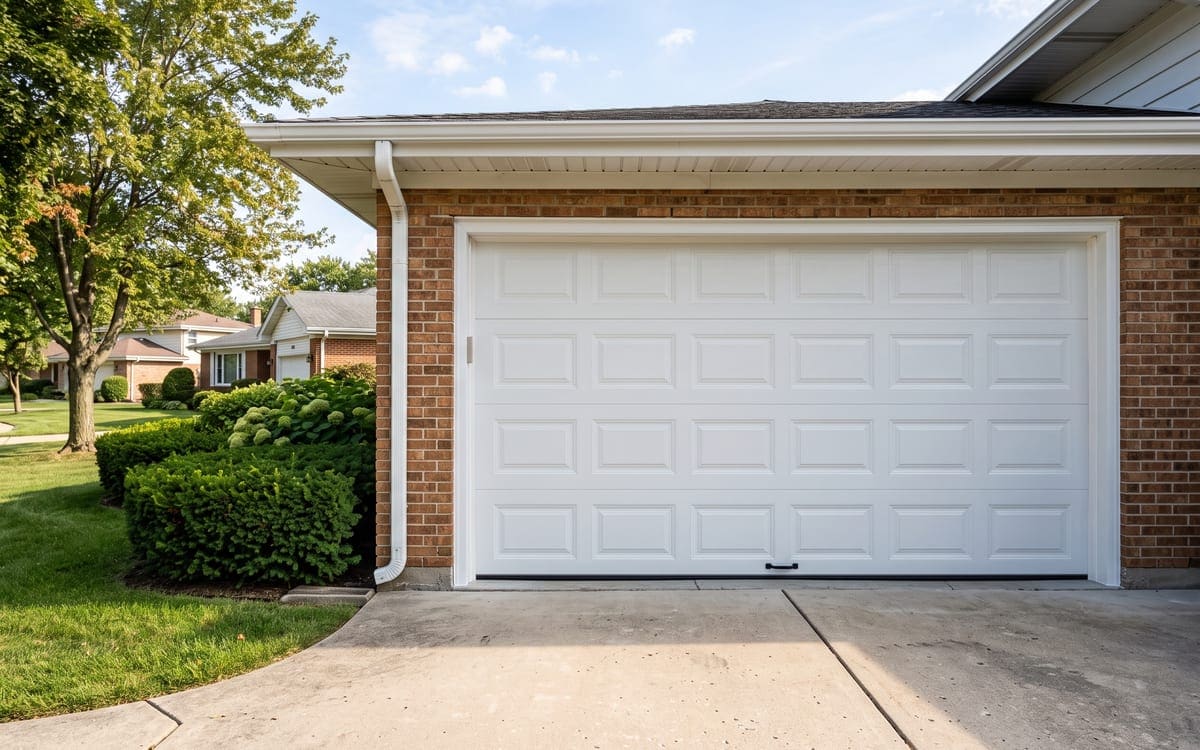
What does a full replacement actually cover?
A garage door is a coupled system: panels, torsion tube, springs, cables, drums, rollers, hinges, tracks, seals and the opener. A full swap addresses the whole assembly at once. The steps below are what our technician does on the visit, not steps for a homeowner.
1. Checking the opening, jambs and header
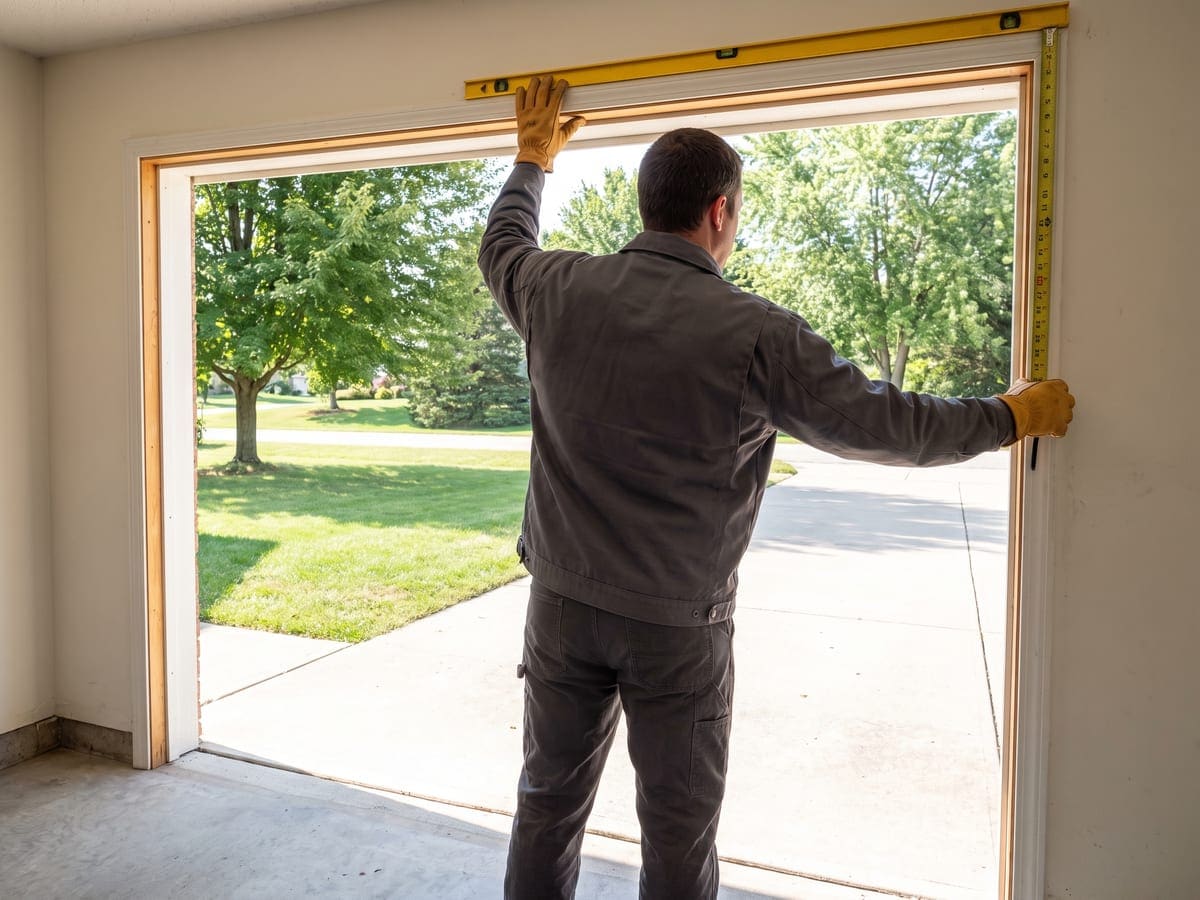
We start with a tape and a level. Wood jambs need to be plumb and thick enough to hold new track brackets. The header must be square and solid, since it carries the opener rail and the torsion tube. Soft, split or rotted wood gets called out before any new door goes in.
2. Taking the old door down safely
Even with an old door resting on the floor, its torsion springs and lift cables carry most of their load. That is why a spring that snaps while the door is closed leaves a door that will not lift: the springs pass their lift to the door through the cables, and once a spring is gone there is nothing to raise the panels. Our technician handles the spring, drum, cable and bottom-bracket work, and the sections then come out from the top down, roller by roller, with the vertical and horizontal track unbolted from the jambs and ceiling. Do not pull the emergency release rope, touch the winding cones or reach for the bottom brackets until we have said the tension is off. Ask about removal of the old door when you call.
3. New tracks, springs and cables sized to the new door
Every door gets track cut for its height and headroom, springs wound for its weight, and cables cut for its drop. Old track rarely lines up with fresh brackets, and old springs were sized for a different panel anyway. Fresh rollers go in as the sections stack.
4. Weather seals and the bottom seal
A new bottom astragal fits to the sill so the door lands on a fresh rubber lip. Perimeter seals go along both jambs and across the top. On an unheated garage this separates a door that keeps out the wind from one that whistles at every gust.
5. Reconnecting or replacing the opener
If the opener runs quietly and its sensors work, we mount the new door on it and reset the travel and force for the new weight. If it is worn, or the head has no safety sensors at the bottom of each track, we talk over a new opener if the old one is worn. We make that call at the door, with the old opener still on its brackets.
6. Balance check and safety reversal
Once the door is up, our technician disconnects the opener arm and lifts the door by hand. A balanced door stops wherever we let it. The opener then goes back on, a full cycle runs, and we test the safety reverse using the photo eyes and a block on the floor.
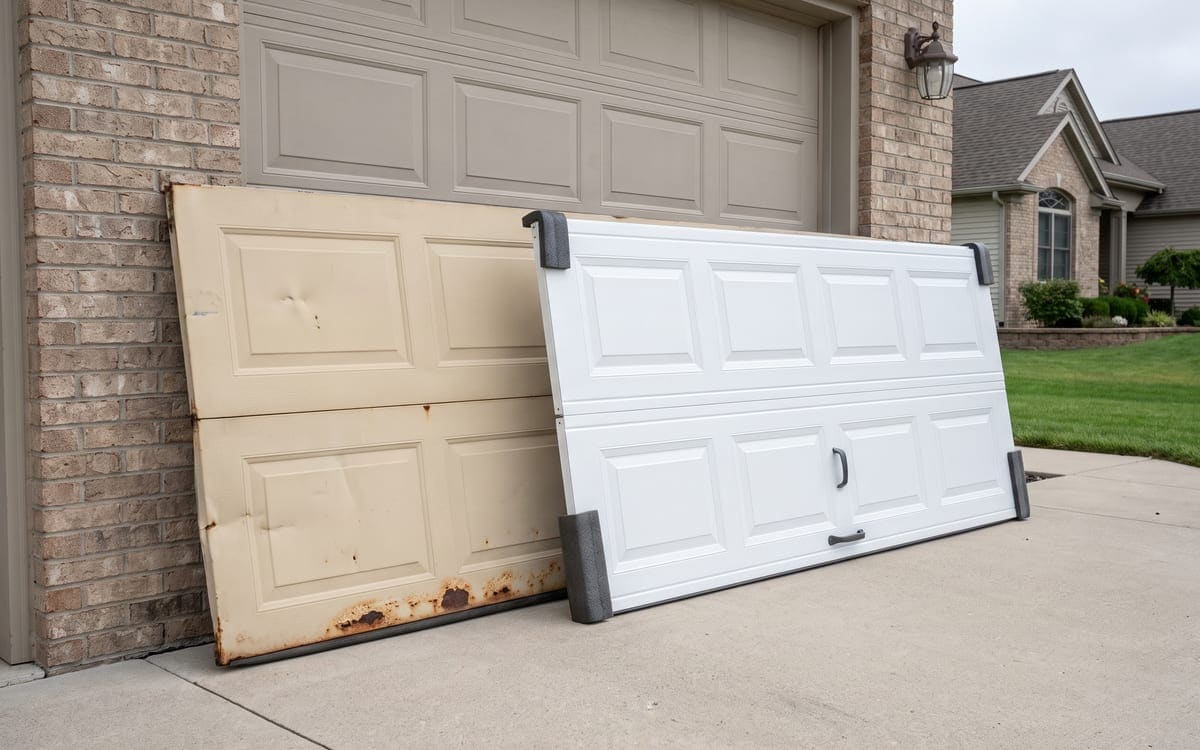
Signs the door is done
| Symptom | Likely cause | What it usually needs |
|---|---|---|
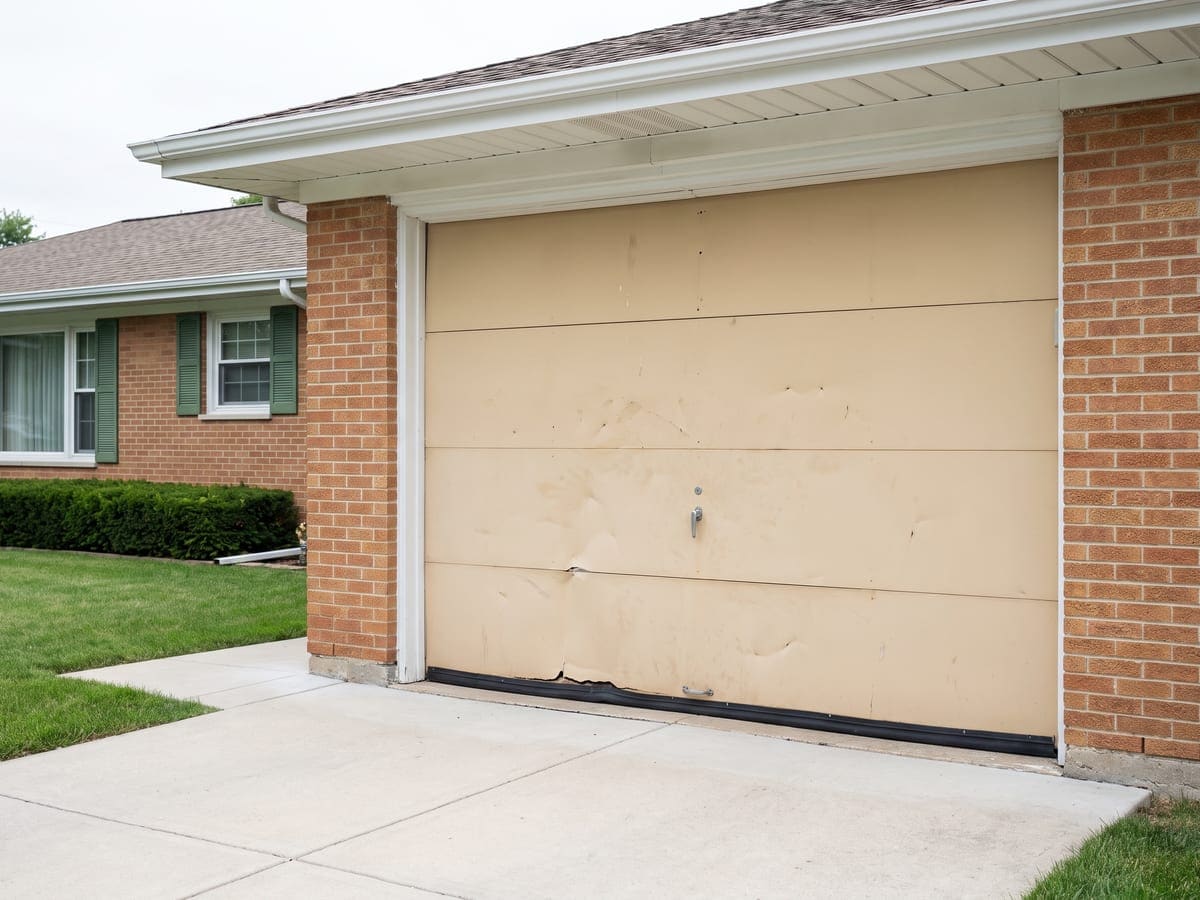
| Cracked or dented panels across two or more sections | Impact, or metal fatigue in an aging door | Full replacement; matching a discontinued panel is rarely possible |
| Rotted wood on a wood or composite door | Water sitting at the bottom rail and jambs | Full replacement; wood past a point cannot be patched cleanly |
| A section is fine but its pattern was dropped | Original design no longer in production | Full replacement rather than a mismatched patch |
| Repeat spring failures on the same door | Undersized springs, or a bent shaft carried forward for years | New door with correctly sized springs and a straight shaft |
| Door will not hold balance after a fresh repair | Bowed sections, tired hinges, or a warped track | Replacement to reset the whole system at once |
| Old opener with no photo eyes at the tracks | External entrapment protection missing | New opener alongside the door |
Keeping the door, or starting over
This is the hardest call on a garage door, and cost often decides it. Our post on how to decide walks through the trade-offs at length.
When we repair it
We repair when the door itself is straight and sound, the panels look right, and one part has failed. A snapped spring on a door that is otherwise level and balanced is a repair. A worn opener on a good door is a repair. A single dented section on a modern steel door often gets replacing one section instead, rather than a full swap.
When we suggest a new door
We suggest replacement when the panels are the problem, when small repairs stack on small repairs, or when parts are no longer made. Fresh hardware on failing panels does not get the panels back, and the door still looks worn once the work is done.
At the door, we tell you which side you are on.
Keep the door, or start over
A straight door with one failure holds; a door with worn parts across the board asks for a swap.
Repair
- The door is straight and one part has failed
- Panels, hinges and tracks are still sound
- Matched parts are still made for the model
A new door
- Panels are cracked through or rusted from inside
- Small repairs keep stacking in a single year
- Springs, cables, rollers and seal are tired together
A note on townhouse and condo doors
In a townhouse or condo, the door face can be covered by the association's rules, while the opener and interior hardware stay with the homeowner. Read the association's guidelines before picking a door, or ask the board for pre-approval, so the new one does not have to come back off.
Parts a full swap needs
Almost every replacement gets new panels, a fresh torsion tube, matched springs wound to the new door's weight, lift cables cut to the drop, drums, rollers, hinges, bottom brackets, vertical and horizontal track, a bottom seal and perimeter seals. What can sometimes stay: a recent opener with working safety sensors, the framing (if the jambs and header are still straight and solid), and the exterior trim.
Old springs never carry over onto a new door. Spring life is counted in open-and-close cycles, and a spring that spent its life on the previous door is not sized for the new one either. For choosing the new door, the installation page walks through materials, insulation and panel styles.
From your call to a working door
- The call. Say what the door is doing, roughly how old it looks, and what brand is on the opener if you can read it from a few feet back. Ring (847) 440-3650.
- The look. Our technician measures the opening, checks the springs, cables and header, and works out whether the door is worth another repair or ready for a swap.
- The work and the tests. We remove the old door, install the new one, balance it, and run the safety reverse and the photo-eye check.
Older housing here and what changes on a swap
Half of the village's houses were built before 1974,1 and only about 9 percent went up in 2000 or later.2 Ceiling clearance in older attached garages can fall short of what a standard rail assumes, which pushes the choice toward a wall-mount opener or a low-headroom track kit. Our note on original doors on older homes covers what else can show up on the visit.
Village housing age by decade
About 44 percent of the village's units were built in the 1960s and 1970s; about 9 percent in 2000 or later.
1974
median year built, village housing
Source: U.S. Census Bureau, ACS 2024 5-year, table B25035 (Median Year Structure Built)
44%
share of units built in the 1960s and 1970s
Source: U.S. Census Bureau, ACS 2024 5-year, table B25034 (Year Structure Built)
9%
share of units built in 2000 or later
Source: U.S. Census Bureau, ACS 2024 5-year, table B25034 (Year Structure Built)