What is the door doing?
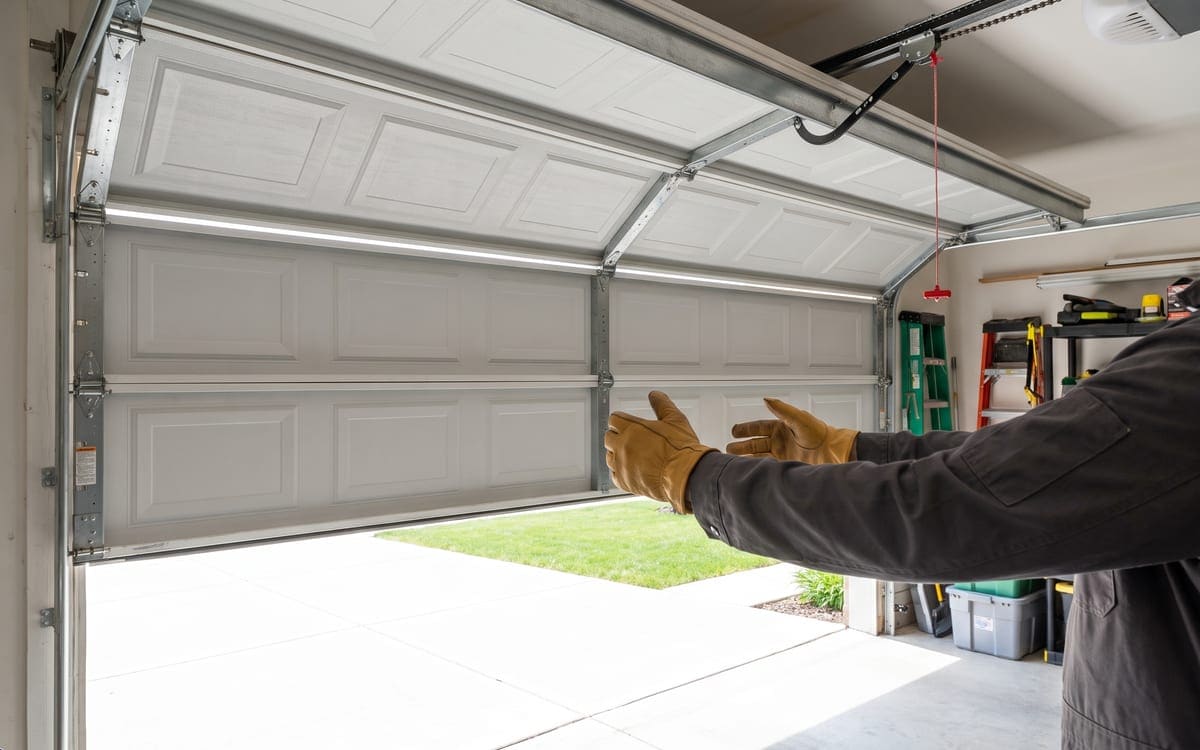
The hardware works in a chain: springs lift, cables carry that lift down to the door, rollers and hinges let it fold, tracks guide it, and the opener rides the trolley along the rail. A failure in one part shows up in the next. Our steps work through the chain in order.
1. Look with the door down and the opener unplugged
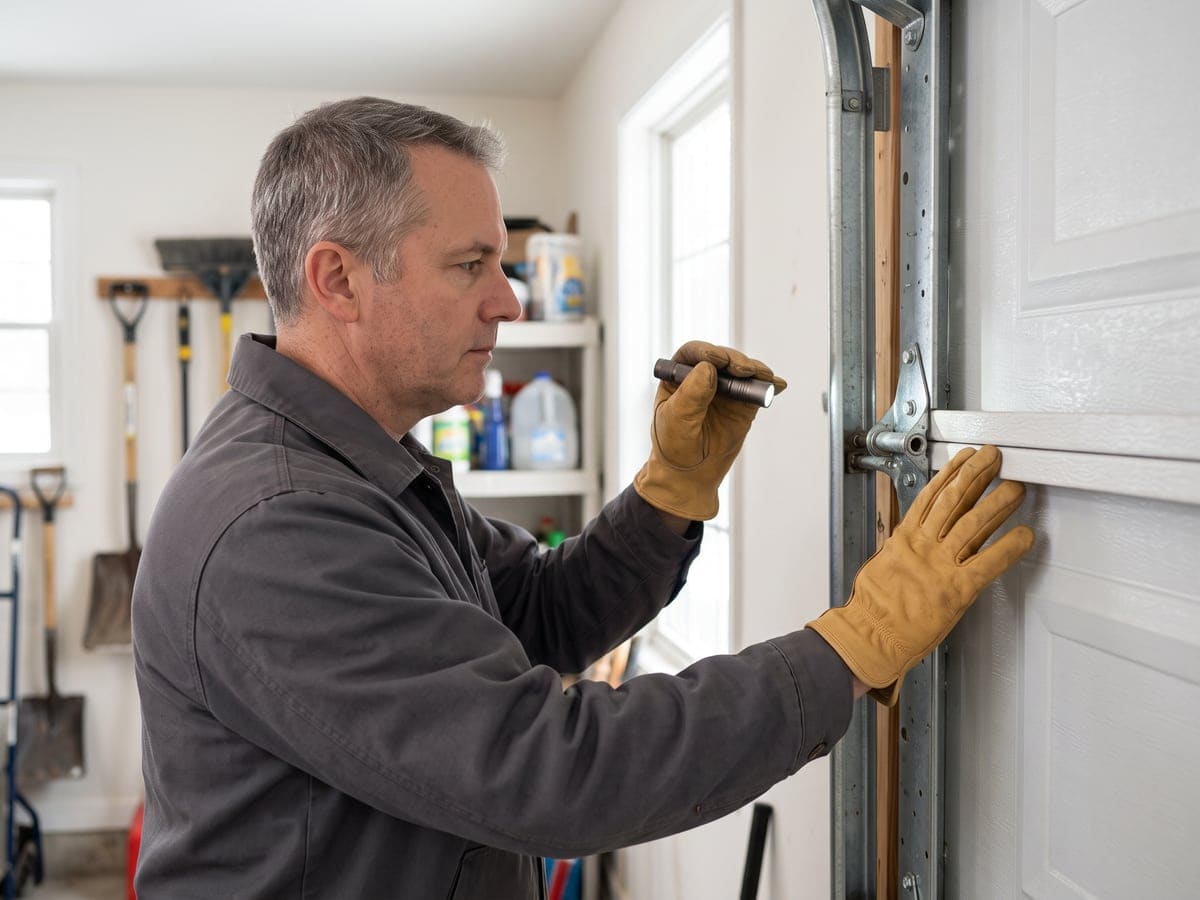
Our technician starts at the driveway with the door down and the opener plug pulled. A slow visual pass tells most of the story: a gap in a torsion coil, a lift cable hanging free of its drum, a bottom bracket pulled off a panel, or a hinge cracked at the pin.
2. Springs
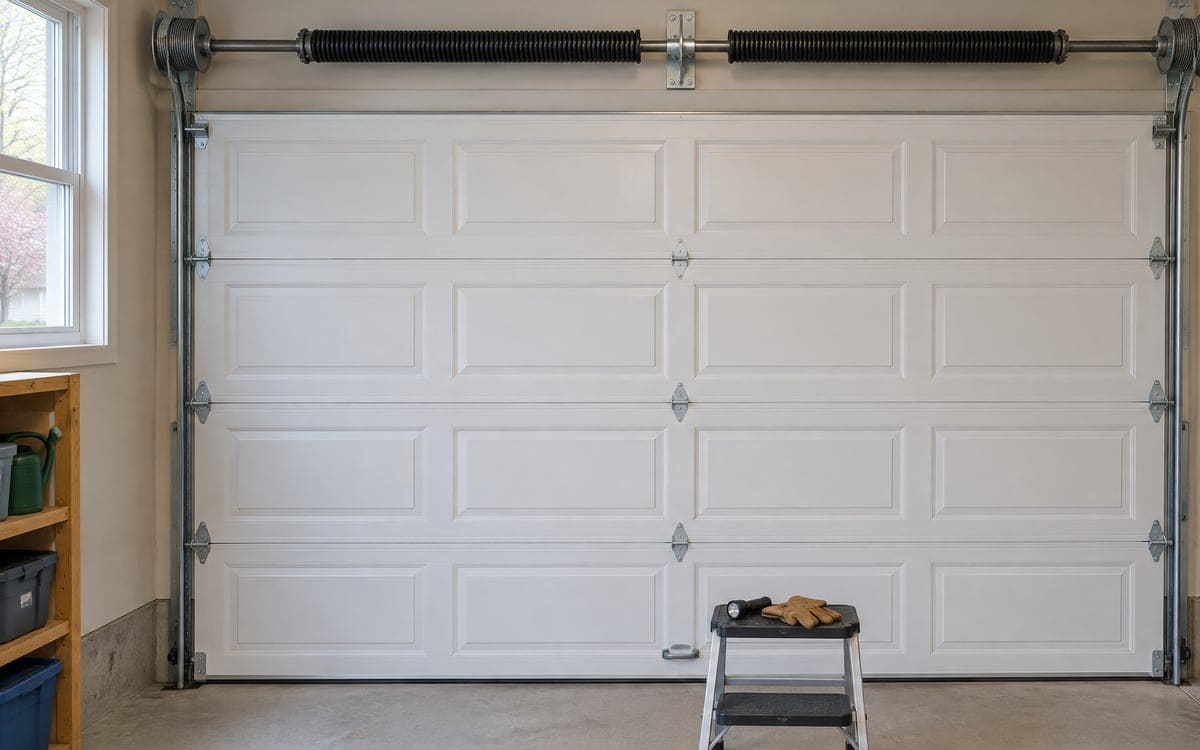
Springs, not the opener, do the lifting. On a torsion setup, the tells are a coil parted across the middle, coils stretched or bunched, a winding cone spun on the shaft, or wobble at the center bearing. On an extension setup, we check for a snapped end, a coil pulled long, and that a safety cable still runs through each spring. If one spring of a matched pair has gone, both come off, since the survivor is on the same cycle count.
3. Cables and drums
Lift cables run from the bottom brackets up each side and onto a drum at each end of the torsion shaft above the header. Those cables carry the most tension with the door closed, when a torsion spring is fully wound. With the door up, spring tension is at its lowest and the cables are nearly slack. We look for a frayed strand at the drum, a wrap that has slipped its groove, or a cable that has jumped off.
Where the springs, drums, cables and bottom brackets sit
The hardware chain that lifts the door, from the torsion spring on the shaft above the opening down to the brackets at each bottom corner.
- Winding cone (outer end)
- Torsion springs one on each side of center
- Center bracket anchors both springs
- Shaft, across the top
- Cable drum
- Cable drum to bottom bracket
- Bottom bracket
- Vertical track
- Rollers in the track
- Four door sections
4. Rollers and hinges
Every roller gets a hand spin while the stem sits inside its hinge. Nylon rollers wobble as they wear, dry steel rollers squeal, and a cracked hinge lets a panel rack and chew the wheels above.
5. Tracks and brackets
A sight down each vertical and horizontal track turns up the obvious trouble. A track bumped by a car shows a kink at bumper height, and the door catches there on every open. Loose lag bolts at the wall brackets let a whole vertical track walk under load.
6. Panels, seals and the bottom fixture
Each panel is read for a creased skin, split stiles, or rust under a dent. The bottom fixture, the bracket the lift cable hooks into, is a hidden hazard when cracked. Cable tension is highest with the door closed and still strong as the door starts to lift. A torn bottom seal lets road salt and meltwater into the base of the door all winter.
7. Opener, rail and sensors, then balance and reversal
With the springs, cables and tracks safe, our technician plugs the opener back in. We watch the trolley, listen for a motor straining or a gear stripping, and test the travel limits and force settings against the door's weight. Then we clear and re-align the safety eyes. An opener problem can trace back to the sensor, the limit switch, the control board, or the drive gear. With the opener disconnected at the trolley, the technician lifts the door by hand to about waist height and lets go; a balanced door stays put, a dropping one has weak springs, and a shooting one has too much tension. Then a nominal one and a half inch piece of lumber goes flat under the door, and the opener closes onto it; the door should reverse, and if it does not, the down force and travel limits get a reset or the opener is flagged for repair.
| Symptom | Likely cause | What it usually needs |
|---|---|---|
| Sharp report from the garage, then a door that will not budge | A broken torsion or extension spring that parted with the door closed | Fresh matched springs and a balance check |
| One side hangs lower after a run | A cable slack, snapped, or jumped its drum | Attention to lift cables and drums |
| Grinding or squealing as the door moves | Bearings dry, wheels worn | A set of worn rollers swapped out |
| Catches at the same spot on every open | A bent or loose track at that point | The track straightened and its brackets tightened |
| Door leans and grinds along the jamb | Bumped or jumped its rollers | Recovery of a door that has left its track |
| Opener hums, door does not move | A broken spring the opener is trying to lift on its own, or a stripped opener gear | A spring look first, then opener trouble if the door is balanced |
| Remote and wall button both dead | A dead outlet or breaker, GFCI tripped, or a bad logic board | A wired opener diagnosis after a quick power check |
| Door opens fine but stops and reverses on the way down | Safety sensors blocked, misaligned or dirty, or close-force set too low | Clean and realign the eyes, then dial close-force in |
| Door has quietly gotten louder over a year | Hardware settling, bearings drying | Booking a full tune-up |
| Door reverses the instant it touches the floor | A down-travel limit sent past the floor, or close-force dialed too low | Opener travel and close-force reset |
| Loud pops, thumps or shakes on every cycle | Loose hardware, dry hinges, tired rollers | Diagnosis on a door that has gotten loud |
Repair or replace
When we repair
Sections are straight, hinges hold their pins, tracks are true, and one part has failed rather than five. Matched parts are still made for the model.
When a new door makes more sense
Panels are cracked through, rusted from the inside, or split at the stile joints. The door has come off track more than once and the sections have racked. Replacement panels are gone. Or repairs keep stacking in a single twelve month stretch. The longer version is on when a new door makes more sense.
What the visit covers
The visit works through the hardware chain: springs, cables, rollers, hinges, tracks, panels, seals and the opener. A specific painted panel, a discontinued control board, or an odd-sized spring is ordered; our technician says so at the door.